
Five Faculty Named 2026 Research Achievement Award Recipients
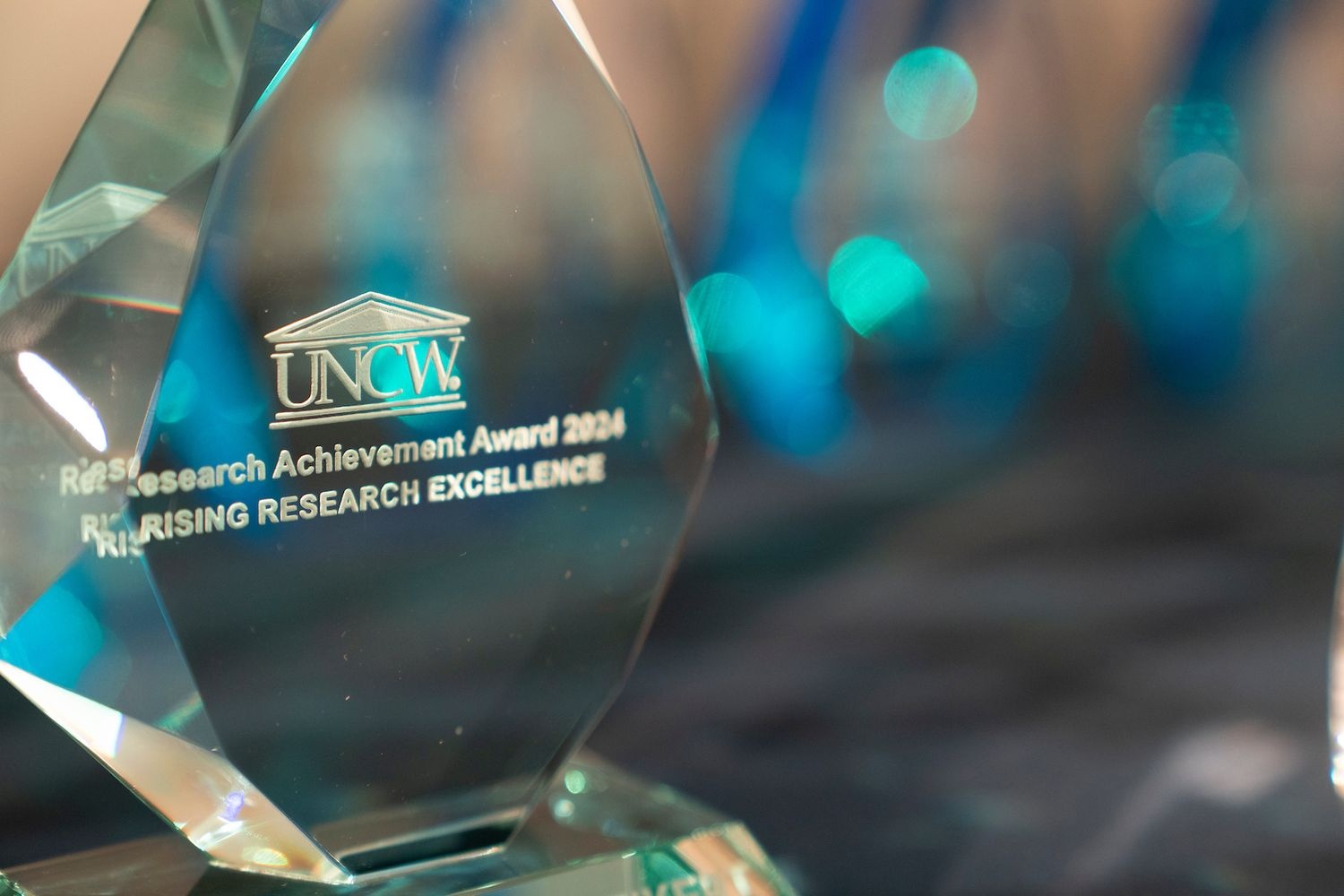
Photo: MichaelSpencer/UNCW
Five faculty researchers have been named recipients of the 2026 Research Achievement Awards for significant contributions to advancing knowledge, discoveries with broad societal impact and the meaningful engagement of students in the research process. Honored with the Rising Research Excellence Award, these faculty are emerging leaders in their fields.
The 2026 Rising Research Excellence Awardees are:
- Hosam Alamleh, Department of Computer Science
- Maia L. Butler, Department of English
- Christina Lord, Department of World Languages and Cultures
- Matthew McLean, Department of Biology and Marine Biology
- Remington X. Poulin, Department of Chemistry and Biochemistry
The awardees represent five departments across the College of Humanities, Social Sciences and the Arts and the College of Science and Engineering.
Below is further information on the 2026 honorees:
Hosam Alamleh, assistant professor, Department of Computer Science
Alamleh’s research examines threats, vulnerabilities and defense strategies for securing autonomous and mission-critical systems, focusing on cybersecurity of unmanned vehicles, maritime cybersecurity, anti-drone technology and infrastructure technologies.
“Beyond cybersecurity, this work has broad implications for transportation safety, critical infrastructure resilience, national security and the trustworthy adoption of autonomous and connected technologies,” said Alamleh. “It helps support safer systems, stronger privacy protections and more reliable digital services in sectors that affect everyday life and economic stability.”
Maia L. Butler, associate professor, Department of English
Butler’s work spans the fields of Black literary studies, Black feminist geographies, architecture and planning studies and decolonial feminism. Her current research models an ecologically and theoretically grounded reading of cultural landscapes represented in the pages of Black women and Black queer writers' "literary geographic imaginaries” – the multiscalar and transtemporal worlds they craft in the pages of the literature.
“These literary geographic imaginaries deepen our understanding of the expansive and complex ways that Black women/folx perform homeplace and worldbuilding practices, offering us 'blueprints to belonging' in diaspora,” Butler said.
Christina Lord, associate professor, Department of World Languages and Cultures
Lord’s research explores literary and cinematic representations of extraterrestrials, animals and posthuman beings, as well as how visual science-fiction iconography migrates and morphs across time, media and cultures. Her work explores how French and American science-fiction storytelling have mapped the shifting of human knowledge, observable reality and new belief systems.
“Science-fiction storytelling from different cultures can serve as a speculative tool for examining the impact of technological, societal and environmental change on individuals, nations and humanity at large,” said Lord. “As a genre of mass popular culture, science fiction both forms and informs the world, thus demonstrating how literary and visual storytelling are deeply embedded in our modern society and our cultural values.”
Matthew McLean, assistant professor, Department of Biology and Marine Biology
McLean’s research focuses on the dynamics, functional roles and biogeography of marine fish assemblages. His lab’s work combines field-based observations with quantitative modeling to understand how fish biodiversity is changing globally and what those changes mean for conservation and fisheries management.
“Our work shows how biodiversity responds to environmental change and human activities, helping inform practical conservation and management decisions,” said McLean. “By collaborating directly with stakeholders and management agencies, we develop research that addresses real-world challenges and support ocean sustainability.”
Remington X. Poulin, research assistant professor, Department of Chemistry and Biochemistry
Poulin’s research is split between developing analytical tools and methods to help bring state-of-the-art novel biotechnology products onto the market and developing better understanding of the nature and role of waterborne chemistry in ecologically and commercially valuable systems. The central theme of his work is the application of modern analytical chemistry techniques to answer interesting and impactful questions.
“My research provides tools for the development of safer, more effective products that benefit the community and also helps us better understand the impact of chemistry in aquatic environments,” said Poulin.
The 2026 Research Achievement Award honorees will be formally applauded at the 19th annual Research Reception in September. For more information on the Research Achievement Awards and to view past recipients, visit the Research and Innovation Awards and Recognition page.