

UNCW, Cameron Art Museum Partner on Arts Integrated Water Curriculum
Courtesy: Dan Johnson
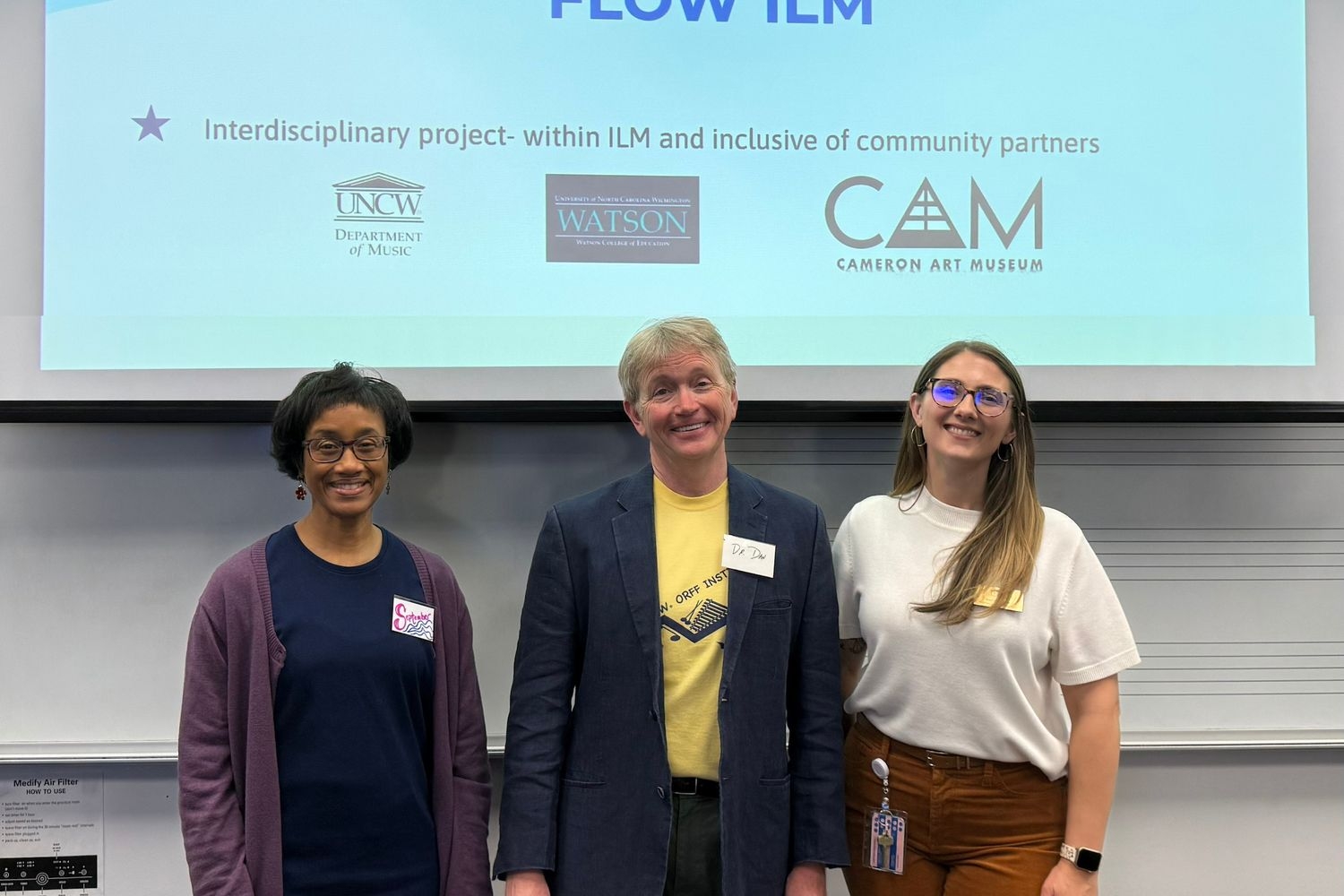
Daniel Johnson and Andrea Perrone are partnering with the Cameron Art Museum and five UNCW graduate students to develop innovative lesson plans that integrate arts education with the study of water. The original lesson plans — introduced in K-8 classrooms this spring — explore aquatic ecosystems through music and visual art while making meaningful connections to science and social studies standards.
The interdisciplinary project, Rivers of Ideas and Oceans of Possibilities: Exploring Water through Elemental Music and Art Education, is sponsored by UNCW’s Office of High Impact Practices and supported by a Flow ILM grant. Johnson said, “We were thrilled to be selected for Flow ILM funding, as our project not only explores water flowing through ecosystems but also the flow of creative ideas.”
“Music and other art forms are essential to interdisciplinary education,” Johnson said. “Authentic cross-curricular learning involves concrete experiences in multiple media that are directly tied to standards in both arts and non-arts subjects. This approach goes beyond superficial connections and promotes disciplinary equity by expanding access to rich learning experiences across the curriculum.”
Johnson is a professor of music and coordinator of UNCW’s Graduate Certificate in Music Education. Perrone is a lecturer in the Watson College of Education’s elementary education program and a former music teacher. They are collaborating with September Krueger, curator of education and public programs at the Cameron Art Museum.
All three are fellows of A+ Schools of North Carolina, an initiative of the N.C. Arts Council that supports schoolwide arts integration to enhance student engagement.
“We’re drawing on our shared experience with A+ Schools to provide innovative professional development for teachers through multidisciplinary integration,” Johnson said. “Our goal is to engage K-8 students using the Orff Schulwerk approach, which emphasizes creativity and self-expression, while connecting music and visual art to science and social studies standards.”
Orff Schulwerk — an internationally recognized approach to teaching music through movement, creativity and play — is central to UNCW’s Graduate Certificate in Music Education. Five graduate students in the program are designing and field-testing their own lesson plans.
The project began in February with planning sessions and a review of two Cameron Art Museum installations, From Mountains to Sea and Living Waters. The team then developed interdisciplinary units designed to engage K-8 students in exploring water as both a natural force and a creative theme, while building the 21st century skills of creativity, critical thinking, communication and collaboration.
The lessons have been shared with local music teachers and are being implemented in classrooms this spring. The project may also be featured at FlowILM in October, a Cameron Art Museum event celebrating the intersection of art, science, education and community.
“Flow ILM grants support collaborations where faculty, students and community partners can learn from one another, experiment with new methods and build bridges to connect disciplines,” Johnson said. “This project emphasizes process over product and aligns closely with the pedagogy of our graduate certificate program.”
Graduate students collaborating on the project represent local schools as well as schools in Winston-Salem, Toledo, Ohio, and Middletown, Virginia. They are: Amber Faulhaber, College Park Elementary, Wilmington; Mary Sumner, Kenansville Elementary School, Kenansville; Martin Pruitt, Griffith Elementary School, Winston-Salem; Michelle Poeppelmeier, Glenwood Elementary School, Toledo, Ohio; and Kaleb Branner, Middletown Elementary School, Middletown, Virginia.
About UNCW’s Graduate Certificate in Music Education
UNCW offers North Carolina’s only graduate certificate in music education with an emphasis on Orff Schulwerk and one of the few such programs nationwide leading to a national accredited Certificate of Completion. The 18-credit-hour program includes intensive summer coursework, classroom-based learning labs and a capstone study abroad at the Orff Institute in Salzburg, Austria.
Students also have access to UNCW’s National Board Certification Support Program, which helps teachers earn the profession’s highest credential and qualify for a 12% salary increase.
Prospective students should apply by April 15, 2026. Classes begin in June. For more information, visit the program website or contact Daniel Johnson at johnsond@uncw.edu.