


Charlie Caputo ’26
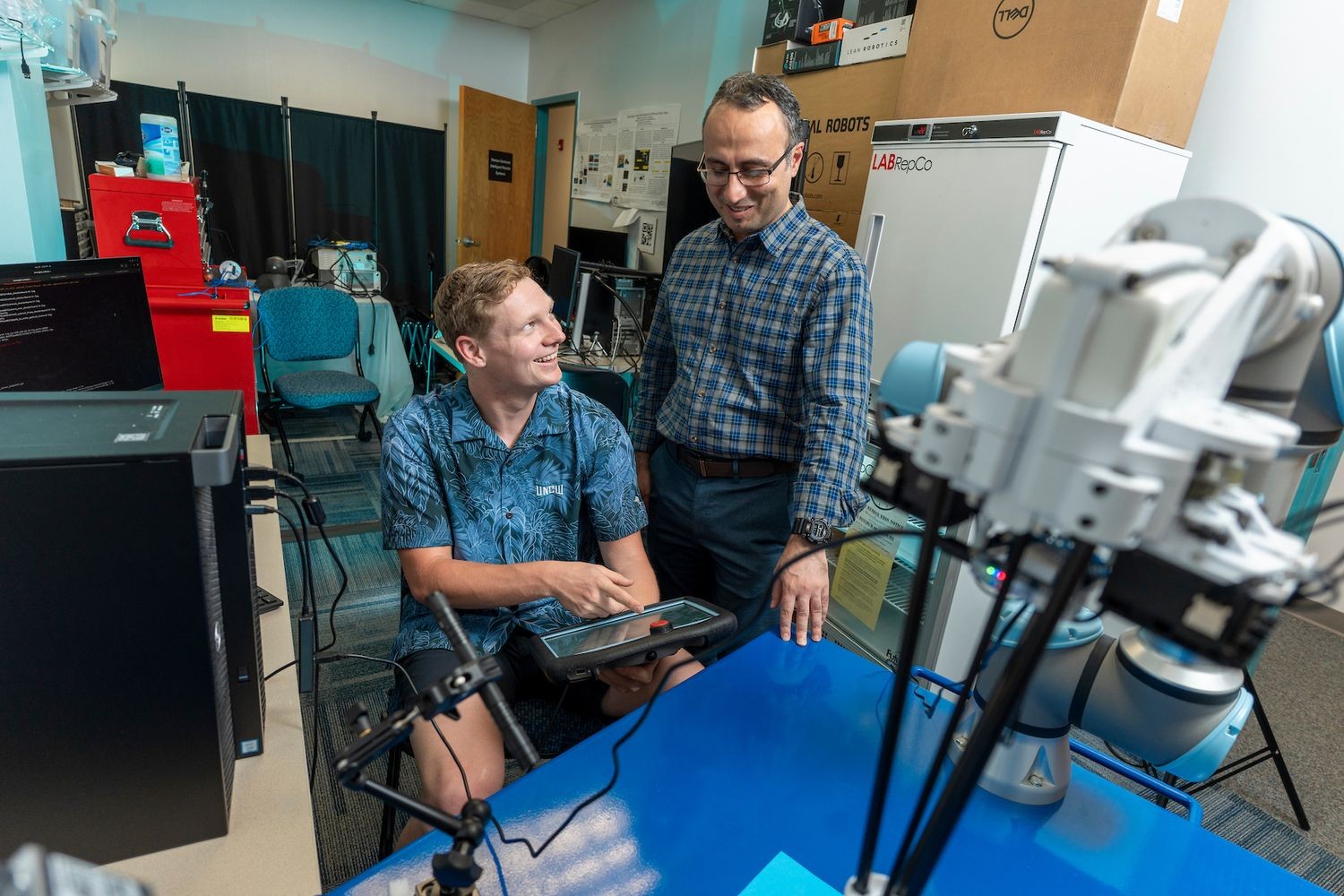
Photo: Michael Spencer/UNCW
As part of UNCW’s first intelligent systems engineering (ISE) graduating class, it is safe to say Charlie Caputo ’26 has done groundbreaking things during his time at UNCW.
Originally from Mooresville, North Carolina, Caputo attended Davidson Day School from kindergarten to graduation. “That school gave me a lot of opportunities growing up and played a big role in shaping my interests,” Caputo said.
It was not until Caputo’s senior year of high school that he was introduced to engineering via a FIRST Robotics Competition. The competition is an international high school robotics program where student teams design, build and program large robots to compete in new games each year while working under real engineering conditions.
Caputo’s passions would soon align even further at UNCW through the recently developed ISE program, an engineering field that focuses on designing and building smart technologies that can sense, analyze and respond to the world around them.
“When I learned about intelligent systems engineering, it felt like the perfect fit,” Caputo said.
Since joining the program, he has worked with mentor and computer science assistant professor Hamed Saeidi on the development of a robotic system designed to assist surgeons during delicate electrosurgical procedures.
“I’ve always wanted to use engineering to make the world a little better,” Caputo said. “Medical robotics felt like a meaningful way to do that.”
At its core, this project focuses on precision. During electrosurgery, intense, localized heat is used in small precise movements to sever damaged tissue or seal blood vessels. Saeidi and Caputo began their work by creating a tool mount and tissue holder via Computer Aided Design modeling. From here, Caputo helped refine a path-planning system for the tools to complete steady, controlled movements during delicate procedures. Instead of having to rely on a steady hand, a surgeon can rely on the robot to maintain delicate, controlled movements.
Currently, he is working on designing the robot to automatically retrieve a tissue sample while still allowing the surgeon to manually step in at any moment.
“The surgeon selects points using a modified version of the path-planning algorithm, and the robot moves to pick up a sample and retract it,” explained Caputo. “The surgeon can take over at any time to fine-tune the motion.”
The ISE program has prepared Caputo for a bright future in engineering. He applied his hands-on research experience to an internship at Fanuc America, an industrial robotics company. There, he assisted in designing and running simulations to help customers understand and select robots that best fit their manufacturing needs. Looking ahead, Caputo wants to continue doing work that makes an impact like the projects he completed in the ISE program.
“I haven’t made a final decision yet, but I’m strongly considering pursuing a master’s degree or Ph.D.,” said Caputo. “I want to continue doing meaningful research.”
As he prepares to graduate, his engineering journey closely reflects the program itself by blending curiosity, passion and technical skills to create real-world impacts.
“Being in the first ISE cohort meant stepping into a lot of unknowns, but that ended up being one of the most meaningful parts of the whole experience. There wasn’t always a clear roadmap, so we had to build one together,” said Caputo. “Looking back, those moments shaped how I approached engineering and gave me a sense of confidence I didn’t have before."