

Rachel Smith ’26M
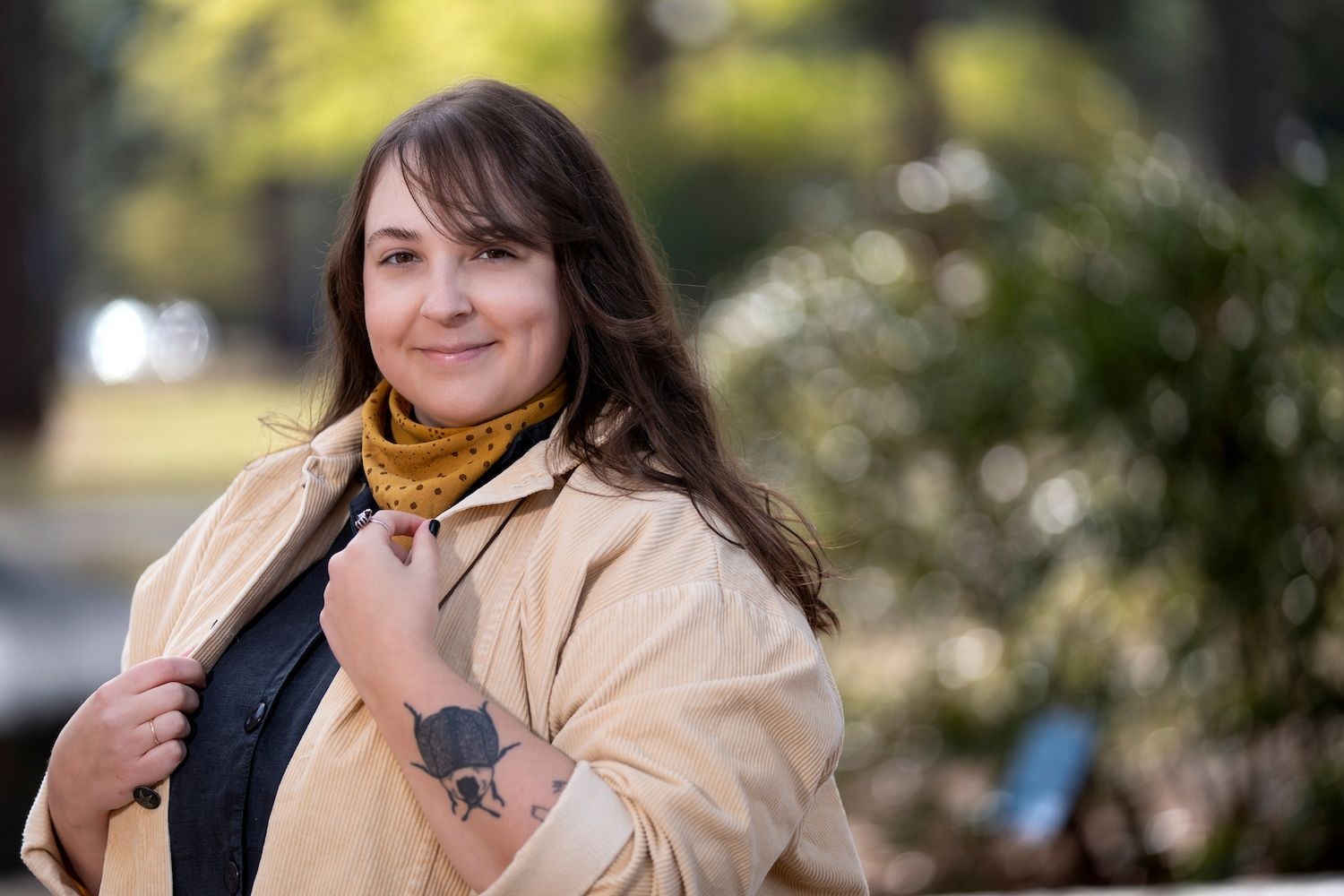
Photo: Michael Spencer/UNCW
When Rachel Smith ’26M says she works the “graveyard shift,” she isn’t kidding. Exploring green burial methods and sustainable death care, Smith serves to have an impact on the environment. Growing up in Summerfield, North Carolina, Smith obtained a bachelor’s degree in design studies with a minor in journalism at NC State University. Feeling unfulfilled working at marketing firms as a copywriter and content creator, Smith began to reconsider her career path at the height of the COVID-19 pandemic.
“I wanted to pursue work that felt more meaningful,” said Smith.
She would enroll at Fayetteville Technical Community College where she would earn a degree in funeral service education.
“As a student, you’re learning how to embalm bodies, perform restorative arts, sell funeral goods, manage and process appropriate documentation, and fulfill other traditional services to families in need,” said Smith.
While at FTCC, Smith developed a strong interest in sustainable death care. Sustainable disposition methods include green burial, aquamation and human composting.
“I quickly realized that I wanted to continue my education and exploration into the ‘greener’ corner of the funeral industry, and as a result, decided to enroll at UNCW, where I am now pursuing my master’s in environmental sciences,” Smith said.
Green, or natural burials, involve the interment of the body in a way that allows it to return to the Earth naturally and with minimal environmental impact. The body may be buried only alongside materials that are fully biodegradable.
Aquamation is a type of cremation that is performed via the use of water. Since there is no fire involved, the process does not use any fossil fuels to power a retort, making it significantly more gentle on the planet. Lastly, human composting is a process that involves breaking the body down into soil using organic material that promotes decomposition. This procedure is currently illegal in North Carolina.
“I think a lot of people are still under the impression that their only choices are traditional burial or flame cremation. While I will always support these practices as valued and needed disposition methods, I love being able to shine a light on and advocate for some of the more Earth-friendly alternatives people may be less familiar with,” Smith said.
With her interest in sustainable disposition methods, Smith is currently conducting research examining funeral service education and mortuary sciences students’ perspectives and intentions regarding green burial practices. This research is alongside Huili Hao, an associate professor of environmental sciences at UNCW.
“We’re seeing a generational shift with younger professionals increasingly entering the field. Understanding how these emerging professionals view green burial is important for identifying the trends and obstacles that could influence the popularity and accessibility of the practice,” Smith said.
Smith is also a part of a small grassroots group working toward establishing a conservation burial ground in southeastern North Carolina.
“Our part of the state is incredibly limited in its options for green burial, so being able to play even a small role in expanding our community’s access to this option is a huge goal —and dream— of mine,” said Smith.
“We’re in the very early stages, but the group we have amassed is incredibly driven. I know it’s only a matter of time before all the pieces fall into place.”
This article has the following tags: Seahawk Stories Academics CSE - College of Science & Engineering myUNCW Research & Innovation