

Arden Ganse ’26
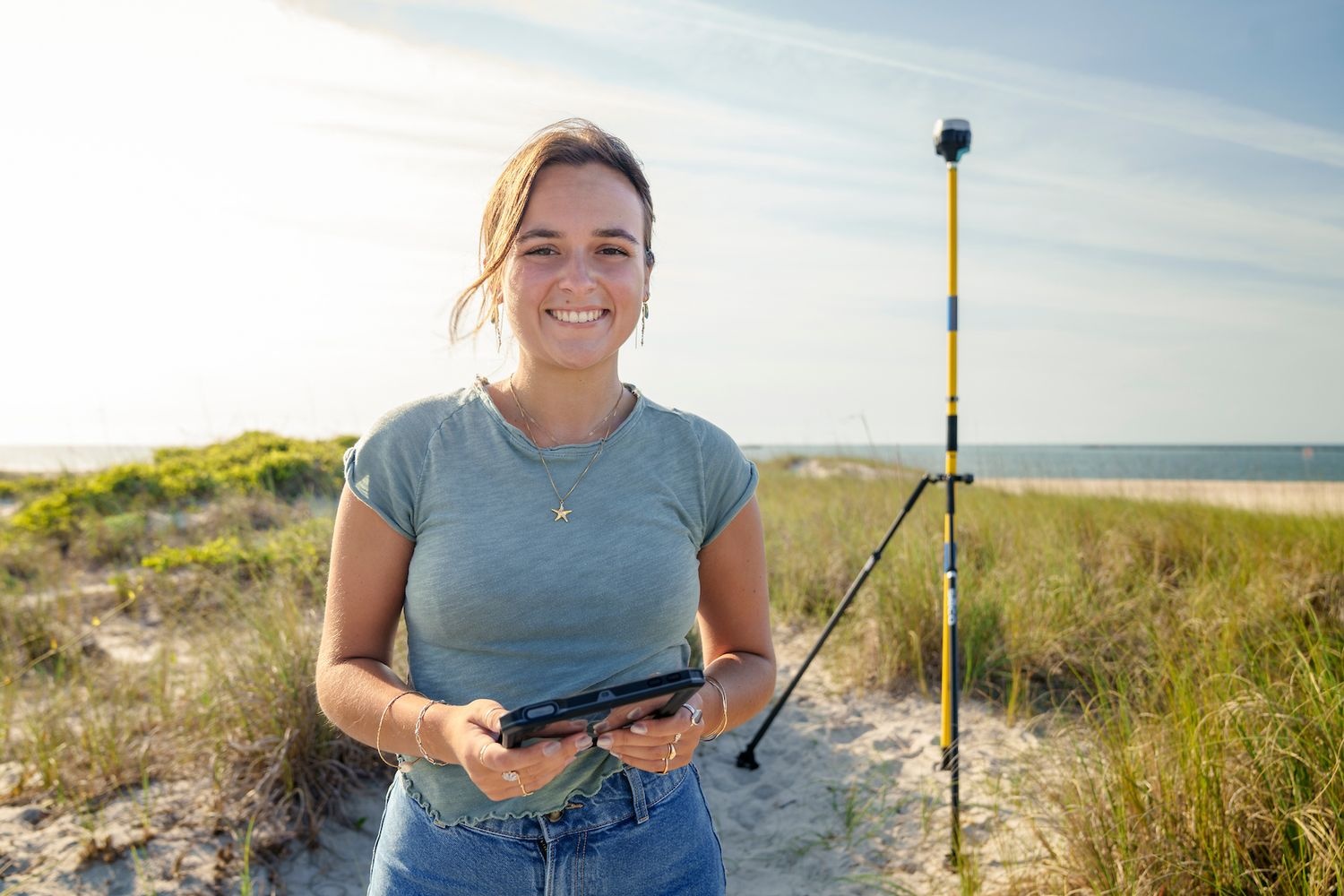
Photo: Jeff Janowski/UNCW
Arden Ganse ’26 first learned about UNCW when her older brother became a Seahawk. She didn’t think then that she would leave her Wilmington, Delaware, home to go to school in that other Wilmington herself, but her growing interest in coastal sciences made it a perfect match.
“I came to UNCW specifically for the Coastal Engineering program,” she said. The young program, launched in 2019, has been growing quickly, but small classes and close faculty interaction still define it. “We have a lot of support and camaraderie,” she said.
A group from her cohort started UNCW’s chapter of the Society of Women Engineers. Arden was among the founding members going into her sophomore year and served as treasurer. The group soon expanded and now has board members from other engineering areas. “We wanted to foster a supportive environment where we were all pushing each other to succeed and build confidence within the field,” she explained.
The Society of Women Engineers is supported by a gift from Leta Huntsinger ’92, recipient of the Extraordinary CSE Alum Award. Learn more about her generous support.
That confidence also comes from experience. She spent the summer of 2025 in San Rafael, California, in an internship at Woolpert, an engineering and geospatial firm, where she worked on the data processing side of a hydrographic survey. Much of the work was outside the scope of typical coastal engineering coursework, but she said employees were impressed with what she had learned at UNCW.
“And I’ve already seen things in my courses this semester that I didn’t anticipate being able to tie back to my internship,” she said. Gaining tangible experience has been the best part of the program for her. Her favorite class has been Field Methods in Coastal Engineering, where almost every week they collected data at the beach, learning to use different instruments and implement experimental methods.
“We were responsible essentially for the entire lifespan of that data,” she said, including processing and analysis. “It was just really very cool for me to have figured something out on my own and used the resources and tools around me and knowledge that I had from other classes.”
She’s putting that knowledge to work on her Honors thesis, examining dune growth on Masonboro Island. She’s adapting a model designed for a beach in Portugal to get depictions of dune growth on the local island. She previously collaborated with Coastal Engineering Program Director Joe Long on his research working to understand barrier islands, and he helped develop a project that catered to her specific research interests.
“That experience of working with a faculty member has been crucial in my college career,” she said. “It has given me a head start. My understanding and learning was a lot stronger than it would have been without that experience.”