

From Moonlit Hatchlings to Marine Labs
How UNCW and the Karen Beasley Center Shape the Future of Sea Turtle Conservation
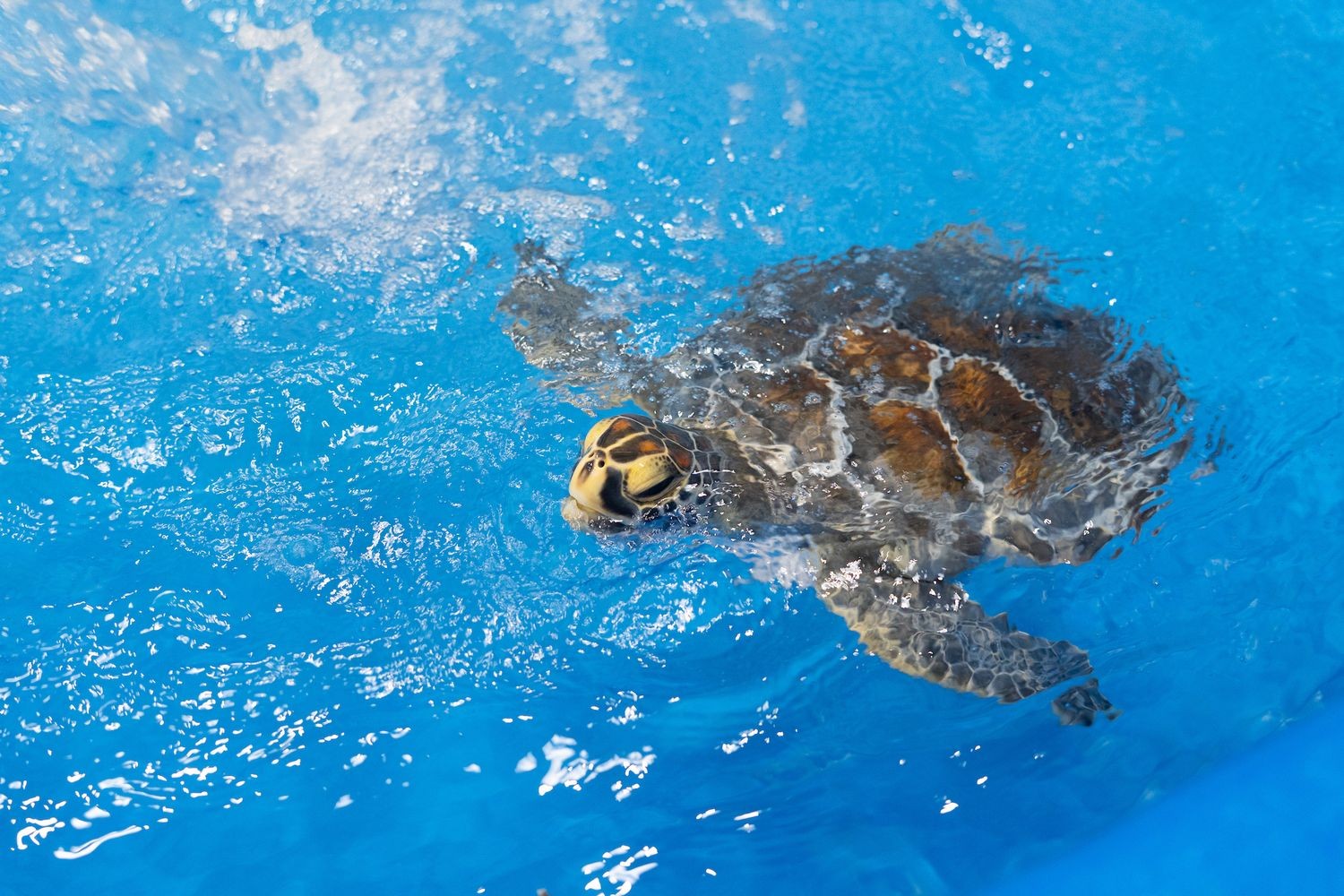
Photo: Maggie Beck/UNCW
I was eight when I first met sea turtles, not in a lab or through my camera lens, but on a stroll along the beach during a family vacation.
I remember taking a deep breath, filling my lungs with the salty cool air, I became curious at the sight of three people making a runway out of sand. My vision, guided by the moonlight, led me to an older woman, who informed me that there is a sea turtle nest here that will hatch soon.
We waited for hours, hoping we would get to see the little creatures. And after almost calling it a night, the sand began to move, and dozens of tiny hatchlings crawled toward the open ocean.
I remember crouching low as volunteers reminded us to turn off our flashlights and then cheering on the turtles with my mom and dad at both sides. Watching them crawl with pure curiosity, some quick to get into the water and some hesitant, all equally determined to reach the crashing waves.
What I didn’t know then was that the people guiding the turtles were volunteers from the Topsail Turtle Project. This volunteer group works closely with the Karen Beasley Sea Turtle Rescue and Rehabilitation (KBSTRRC) Center in Surf City. That night planted something in me, a respect for the oceans and the people who dedicate their lives to protecting them.
The Local Legacy: Jean and Karen Beasley
A decade later, the same shore where I first learned about sea turtles is now the home for UNCW students and volunteers who are continuing to care for and educate the youth about coastal conservation and research.
The center's (KBSTRRC) mission started with a mother-daughter duo's passion for sea turtles. Karen Beasley, the center's namesake and daughter of Jean Beasley, was just eight years old when she first decided she wanted to devote her life to caring for turtles, which mirrors the same age I was when I watched them hatch for the first time.
Although Karen passed away young, her passion was carried through her mother, Jean Beasley, founder of the Topsail Turtle Project and eventually KBSTRRC in her daughter's memory. Starting from a handful of volunteers marking nests up and down the Carolina coast, it soon turned into a nationally recognized center focusing on rehabilitation. Today, the center is also known for education, offering hands-on experience for college students.
Jean developed the UNCW internship program, where students gain professional and hands-on experience working with endangered or threatened sea turtles. Jean's hard work earned her the title of North Carolina's Wildlife Conservationist of the Year. “She built this whole amazing organization,” said Kathy Zagzebski, the center’s current executive director.
Jean retired at age 86, passing away at 90 in early December 2025. Her impact will continue to help students as well as advance sea turtle conservation and research. Jean's mission continues to guide every volunteer to “Just keep swimming.”
A Community Rooted in Passion
After Jean's retirement, the center needed a new leader. Kathy Zagzebski was no stranger to marine care, earning her master's degree in environmental management from Duke University before working with marine animals across the country. She worked with the stranding network. “We covered 600 miles of coast,” said Zagzebski, “and I was responsible for all of that.” She helped every marine animal across that huge stretch of coast and that experience eventually led her to Surf City, where she now serves as the executive director of the KBSTRRC.
The center has cared for over 1600 sea turtles, and at the center's core are volunteers. Volunteers complete the day-to-day tasks required to give every turtle satisfactory care. “This place wouldn’t exist without volunteers,” Zagzebski said. “We were 100% volunteer-run until a few years ago.” Today staff, interns, and volunteers keep the center running through daily animal care and data work.
It's more than a hospital; it's a community where every person has the same goal. “I’ve never been somewhere that has such an amazing group of volunteers,” said Mary Brandal, a recent UNCW graduate who currently works as the education associate at the center. “It’s so nice to have everyone centered towards one goal; everyone just wants to help the turtles in any way they can. So being here and being around people with positive attitudes towards turtles has been really amazing.”
Science in Action: UNCW's Student Research with Goals
Back in Wilmington, the next generation of turtle researchers are hard at work inside UNCW’s Dobo Hall, which supports the Ramirez Lab when performing research outside UNCW's Center for Marine Science. Where students like Olivia Trahan, a senior majoring in marine biology, are trained by Ph.D student Jamie Clark, who spends their Fridays imaging sea turtle bone sections to analyze growth rings.
Skeletochronology - One Friday after class, Trahan gives me a look at the process of skeletochronology. “We can age turtles using their humerus by taking a thick section using a microtome,” says Trahan. “Then they go through a special staining process, and after a couple of days, we mount them on a slide and name them with the [National Sea Turtle Stranding and Salvage Network] sea turtle stranding identification number [a way to track individual turtles].” From here, Trahan and other students of on the ‘Turtle Team’ within Dr. Matthew Ramirez’s lab can now determine the age of the turtle. “Each growth ring represents one winter in a turtle’s life,” said Trahan.
Bone and Biology - Clark shares what you can learn from turtles based on their bones alone: “We learn SO much about sea turtle biology through their bones, such as back-calculated body, or shell, sizes for each growth ring, which allows us to calculate growth rates over time," shares Clark. "Additionally, chemical tracers called ‘stable isotopes’ tell us what that turtle was eating throughout its life and where it was traveling, valuable information that is extremely difficult to acquire in situ."
Data gathered from skeletochronology is key data that can influence population management and conservation needs, building a bridge connecting the UNCW lab to the turtles in the Topsail rehab tanks that help provide a base for their research.
Making a Difference
Every semester 10 students get picked to join the UNCW internship program at Karen Beasley. “Students drive the operation,” said Zagzebski. Students learn and lead educational tours and gain hands-on experience with the turtles.
Trahan was one of the lucky students to be picked. “That internship was a really great stepping stone to launch my career in marine biology,” said Trahan. “You feel like you’re making a difference when you’re feeding the turtles or giving them enrichment, and seeing them released back into the wild is the most incredible feeling.”
The center reshaped her ideas towards her research. “The Karen Beasley Sea Turtle Rescue and Rehabilitation Center helps me understand the research I do on a deeper level,” said Trahan. “Getting to know more about the species’ biology and ecology first before coming into a lab setting was overall really helpful. And without that experience, I don’t think I would have gotten my role in the lab.”
Her experiences at the center inspired her to conduct further research, and she is now completing her departmental honors thesis on how turtle growth rates vary following a 2022 mass mortality event in the Gulf of Mexico.
Ph.D. Research Fueled by Karen Beasley
Beyond undergraduate internships, the rescue center extends research opportunities to Ph.D. student Jamie Clark, specializing in integrated, comparative, and marine biology, who is working on innovative age-estimation tools that could transform the future of sea turtle research and conservation.
“My collaboration with KBSTRRC has been instrumental in advancing my Ph.D. research,” said Clark. “Working with live turtles rather than samples from stranded individuals has been a rare and rewarding opportunity.”
Clark became close friends with full-time Kemp's ridley turtle, Lennie, at KBSTRRC, collecting spectral scans and skin biopsies from her. Her research combines resources from the Ramirez lab, KBSTRRC, and UNCW’s Center for Marine Science. Clark's work will provide noninvasive tools to predict age in deceased sea turtles faster and predict living sea turtles' age with improved precision. This kind of discovery had been unattainable till now.
“My Ph.D. dissertation research is focused on developing and validating age estimation tools,” said Clark. A “Spectral clock” via Near-Infrared Reflectance Spectroscopy (NIRS) an “epigenetic clock” via DNA methylation (DNAm)—for aging Kemp's ridley sea turtles in collaboration with NOAA Fisheries.” These methods use light signatures and DNA patterns to estimate a turtle's age. Unlike traditional skeletochronology, which usually requires a deceased turtle, Clark’s tools work on living animals.
Her work shows how Karen Beasley's mission now extends into university research, shaping not only education but also the future of sea turtle conservation and research.
Threats They Face: A Call to Action
As students and volunteers work tirelessly to help rehabilitate wild sea turtles, the turtles themselves face a number of challenges.
Zagzebski shares that the two biggest challenges are climate change and plastic pollution. Increasing temperatures now warm the sands and skew the sex ratios of turtles; “In some areas of Florida,” said Zagzebski, “up to 99% of hatchlings are now female.” Such extreme female-dominated nests threaten the future stability of the species.
On top of that, “Plastic looks like food to turtles,” said Zagzebski. “One turtle passed 14 grams of plastic, which is the weight of three credit cards.” These are major threats to conservation. A call to action is needed; the community and world as a whole need to do better.
The Next Generation
For UNCW students, both undergraduate and graduate, the Karen Beasley Sea Turtle Rescue and Rehabilitation Center is a place where knowledge fuels further research.
Marine biology majors Caitlin Wallace-Giddings (senior) and Axel Wallace (sophomore) share their experience working in the Ramirez lab and their time at Karen Beasley.
“UNCW has offered us a lot of wonderful opportunities to explore sea turtle research that is not possible at a lot of other universities," said Caitlin. “They are pushing a lot of opportunities forward.” Caitlin and Trahan were in the same cohort at Karen Beasley, and with Wallace, perform weekly sea turtle bone imaging together in the Ramirez Lab ad the Richard M. Dillaman Bioimaging Facility in Dobo Hall.
“As a sophomore, just being able to do this super early is really cool,” said Axel Wallace. “The fact that we have a microscopy [bioimaging] lab right on campus is again really cool.”
To further fuel the new generation, Zagzebski hopes that the center can soon expand with a dedicated education building, where university programs and the Topsail Turtle community can meet.
Coming Full Circle
11 years after my first experience with sea turtles, I think about how the universe has a weird way of connecting people. Who would have thought that I would be the same age as Karen Beasley was when she first realized she wanted to devote her life to turtles and that the Topsail Turtle Project her mother Jean founded would be the very people that educated me about turtles at eight years old.
Revisiting the same beach years later, I am returning not as a kid with a flashlight but as a journalist sharing the story of our coastal community. Watching the new generation of UNCW students carrying the same mission forward, now understanding the network of people behind rehabilitation. While realizing it's not only saving sea turtles. It's about returning to the places that help shape us; it's about community, about believing that, like the tide, healing can always come back.
Help the Turtles!
Visiting the center, adopting a turtle, or buying something off their wishlist makes all the difference. Learn more about all the ways you can donate here: https://www.seaturtlehospital.org/
All research includes proper permitting: NC WRC 25ST41, issued to Dr. Matthew Ramirez and UNCW IACUC A25-024.
This article has the following tags: Center for Marine Science