


Professor Emerita Invited to National Ceremony Honoring Biography Subject
Courtesy: Carole Fink
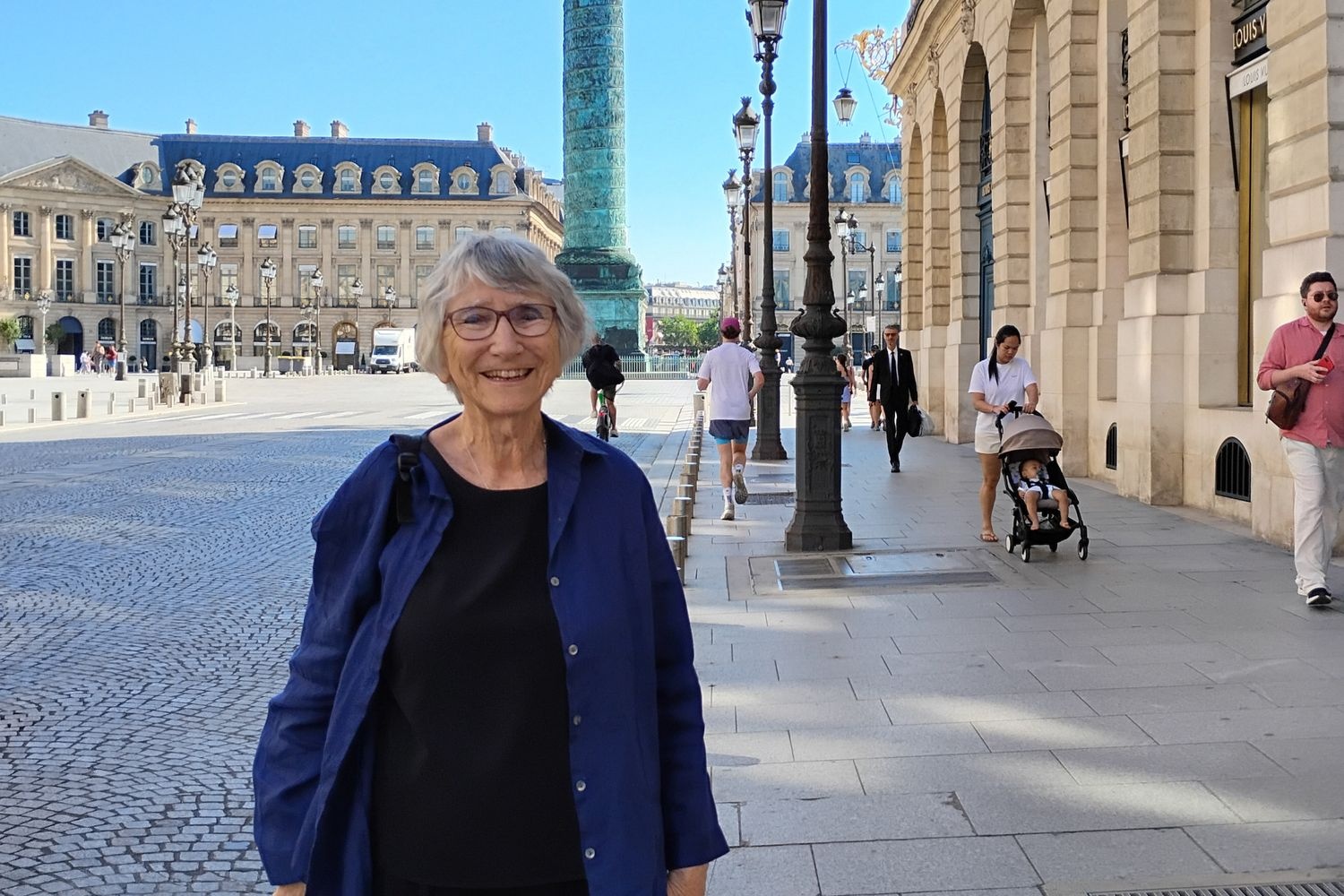
It’s been nearly 40 years since Carole Fink published her pivotal biography of French historian and resistance leader Marc Bloch, and it came full circle in late June when she visited Paris to attend a national ceremony honoring his legacy.
Fink had received an invitation from French President Emmanuel Macron for the event, in which Bloch and his wife, Simonne Vidal, were inducted into the Panthéon, a former church that houses the remains of distinguished French citizens.
Despite the backdrop of extreme summer heat in Paris, Fink, professor emerita of history, said the ceremony was a “magnificent national occasion,” bookended by interviews and meetings seeking her unique perspective on his life.
“Bloch was a hero to my generation; we revered him for his pathbreaking scholarship and personal courage,” she said. “He was a man we all read and admired.”
Bloch is the most widely translated French historian, a man who fought in both world wars and was a professor of history at the universities of Strasbourg and Paris. After France was defeated in June 1940, Bloch, who was a Jew, fell under Vichy France’s racist laws but was granted an exemption to teach for two years in the southern unoccupied zone. After all of France fell under the Nazi yoke in late 1942, Bloch joined the French resistance at age 56. He was captured in March 1944, brutally tortured, and executed by the Gestapo along with 29 other prisoners on June 16, 1944, shortly after the Allied invasion of Normandy.
Fink, who joined UNCW in 1978 as a German historian, was teaching World War I when she came across a fragment of Bloch’s account from the war. Traveling to Paris to find the original manuscript led to a meeting with Bloch’s son and gaining access to a trove of his personal files. She recalled reading Bloch’s daily accounts of his battlefield experiences, laying out maps on the floor to trace his movements through four years of trench warfare and visiting some of the sites herself.
After the translation was published in 1980, Fink embarked upon a full-scale biography. Plunging into French history was a challenge, but she said the opportunity to examine Bloch’s life through interviews with his loved ones, students and compatriots was a privilege. She published “Marc Bloch: A Life in History” in 1989, and scholars since then have delved further into his research methods and intellectual world.
Summing up his legacy, Fink said "Marc Bloch had a vast range of interests, which included the creation, dissemination, and reception of 'fake news' as well as the origins, evolution, and decline of human institutions. And unlike his French contemporaries, Bloch was a comparative historian, who didn't fit in a box.
"But what really strikes me about Bloch in all the years I worked on him was his strong conviction that history does not simply focus on chronology. It involves asking very serious — and even urgent — questions of the human past; questions about power and how it has operated, about the effects of technology and how people have adapted, and about mentalities, and how they have been formed and changed. Bloch’s scholarship also taught us how the past and the present relate to one another, thus providing a richer and more critical perspective for understanding the contemporary world."