


Grad AI Research Sets Stage for NASA Internship
Courtesy: Luke Butler
Creating a custom large language model to connect UNCW student experiences around different wellness topics was a different sort of challenge for Luke Butler '24, '26M.
After he signed on to the Hawk AI project in spring 2025, the work moved quickly: indexing more than 400 student papers and engineering a Retrieval-Augmented Generation (RAG) system that would go beyond keywords to take emotional context into account.
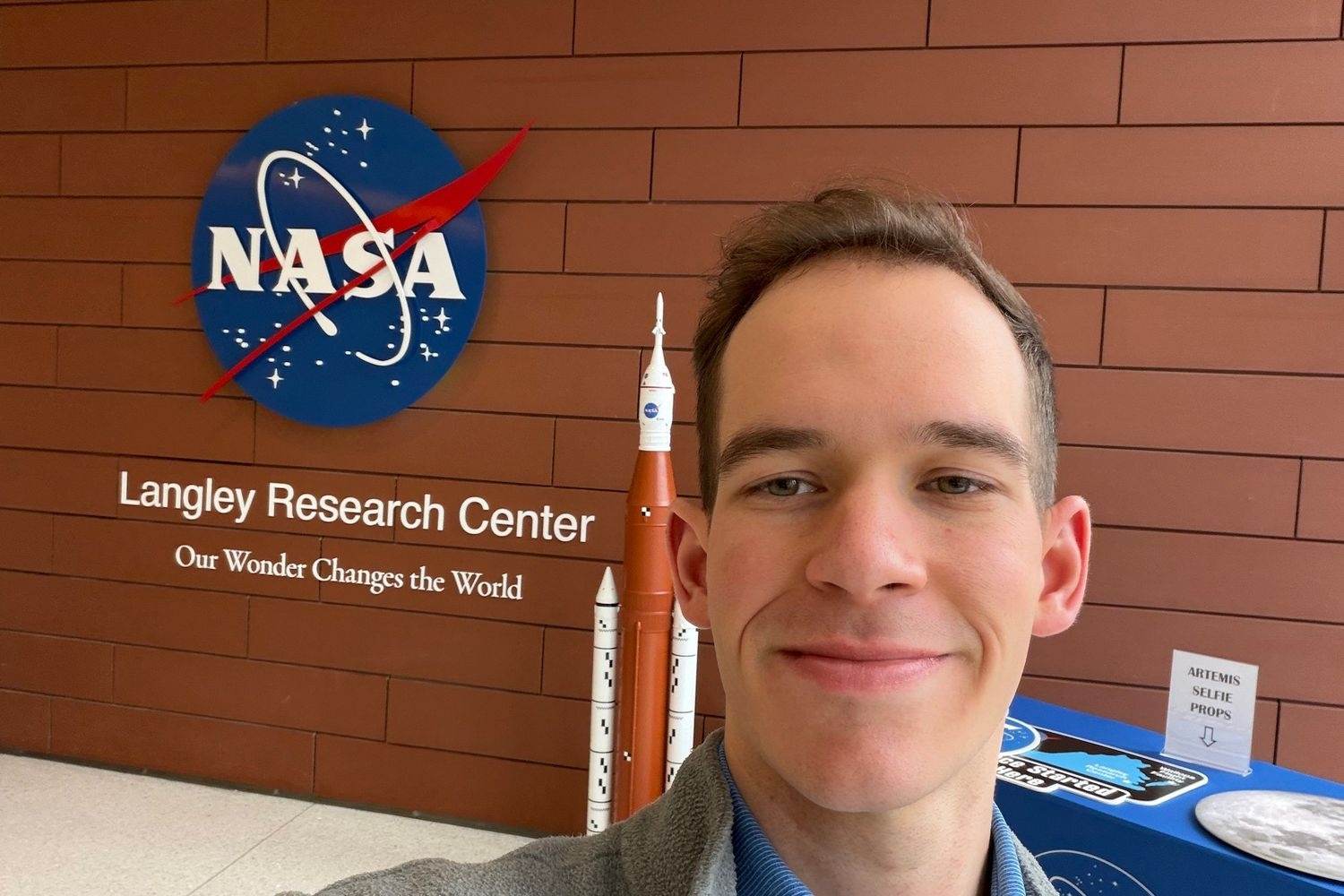
The collaborative project was a deep dive into software system design, and just a few months later, it helped him land an internship in systems design innovation at NASA Langley Research Center in Hampton, Virginia.
“The people here are just great,” Butler said. “I wake up every day and I’m excited to come here and get to solve hard problems and design amazing things.”
At NASA, Butler works with an interdisciplinary team building data infrastructure to model and analyze complex organizational processes. And although the context is different than that of Hawk AI, he said his work process is similar — translating a concept into a concrete use of software.
Hawk AI started off conceptually in 2023 when Shane Elliott and Doug Engelman, faculty in the Department of Sociology and Criminology, posed the question, “What does wellness mean for students, and how do we incorporate that into a chatbot?”
Elliott then introduced the project to his sociology capstone course, where students wrote about and shared their experiences of personal and emotional issues. Rather than feeding those papers to an existing chatbot, the team soon realized they would need to create their own anonymized knowledge corpus.
That’s where Butler entered the picture. Coming from a computer science background, he said it took him a while to wrap his head around this more abstract concept.
But in his words, “What I really enjoy doing is taking a problem, trying to solve it, and then hopefully being able to spin up custom software for it.”
The Hawk AI team, which also includes Sang Teck Oh, assistant professor of sociology, are working on a research paper for the project. With the model still in prototype, it’ll likely be the first paper of many.
Elliott said they want Hawk AI’s next iteration to be more interactive with future users, though he adds it was never intended to be a therapist or coach.
“The challenge we see that’s also an opportunity is students writing about traumatic things like assault or abuse — most LLMs aren’t going to engage with those topics,” he said. “But we’re supposed to make a human-to-human connection over these things. How do we manage that, how do we bridge that gap? That’s the next challenge for us.”
With Butler busy at his internship until his planned graduation in May, his chapter with the project has closed. Between working with such a close-knit team and expanding his horizons by working outside of his usual domain, “I’m so thankful for Hawk AI.”
This article has the following tags: myUNCW Research & Innovation Research & Innovation Students & Alumni College of Humanities, Social Sciences, & the Arts Sociology & Criminology