
Castagno Revisits Grand Opera House
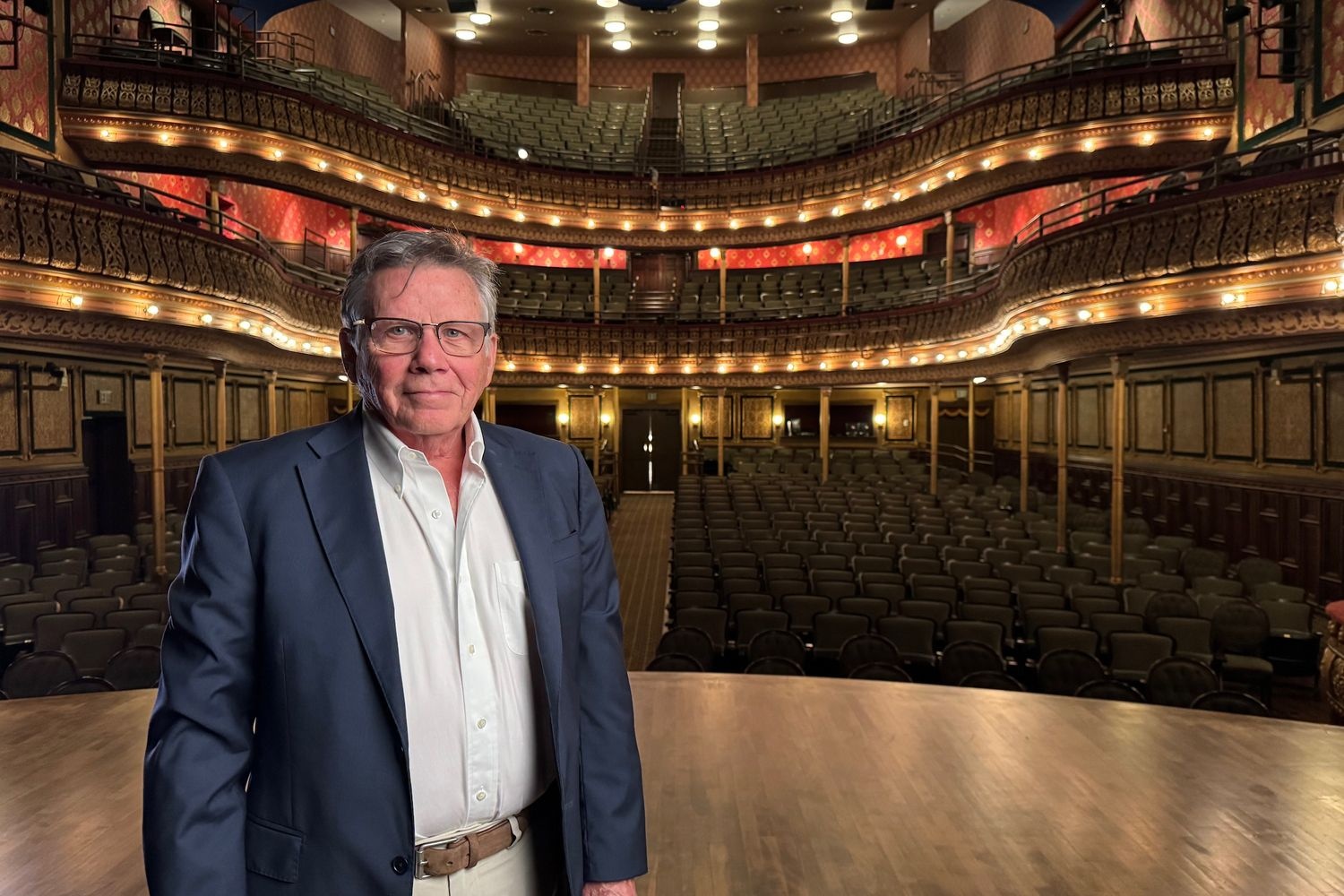
Courtesy: The Riley Foundation
Seeing the swooping, gilded balconies and warm lights at the old Grand Opera House in Meridian, Mississippi was a full-circle moment for Paul Castagno.
“It blew my mind, it looked fantastic,” he said.
Years before Castagno came to UNCW and founded the Department of Theatre in 2005, he knew the landmark historic building as a dilapidated shadow of the venue it’d been in ages past. Then a fledgling theatre professor, he launched a National Endowment for the Humanities research project to study not just the theater’s grand architecture, but its role in Meridian’s history.
He recalled driving an hour to the town in the oppressive summer heat and listening to elderly interviewees reminisce about childhood visits and dates at the opera house.
Originally built in 1889, it was the centerpiece of live entertainment in Meridian, which was in its heyday at the confluence of several railways. Castagno said that made it easy back then to book top shows for a night as they traveled between New York and other larger cities like New Orleans.
The venue later pivoted to showing films, but a combination of factors led to its closure in 1927. And generations of Meridian residents have since yearned for its restoration to former glory.
Castagno’s work was pivotal to realizing that dream. His 1991 study paved the way for the Grand Opera House to gain national status with the League of Historical American Theaters, and it was declared by the legislature as the official state theatre of Mississippi. Continued interest and funding culminated in extensive renovations and a grand reopening as Mississippi State University Riley Center for Education and Performing Arts in 2006.
“It kind of regenerated the community, if you will,” he said. “I didn’t realize that this document had been such a catalyst for all this activity.”
Invited back to the Riley Center on the eve of its 20th anniversary for a community discussion and series of interviews, he felt an outpouring of gratitude from MSU faculty and staff, members of the Riley Foundation and the community. He sang high praises for the stunning restoration that has reinvigorated appreciation for the arts in Meridian.
Without the buy-in of key supporters and the institutional support of the university, Castagno said other historic theatrical venues aren’t so fortunate.
“I think it shows that it’s part of a larger picture,” he said of the opera house’s saga. “That building is emblematic of the city itself, what it was and what it can be.”