

UNCW Partners with Japan Aerospace Exploration Agency
The international partnership places UNCW among a small group of research teams leading next-generation satellite precipitation research.
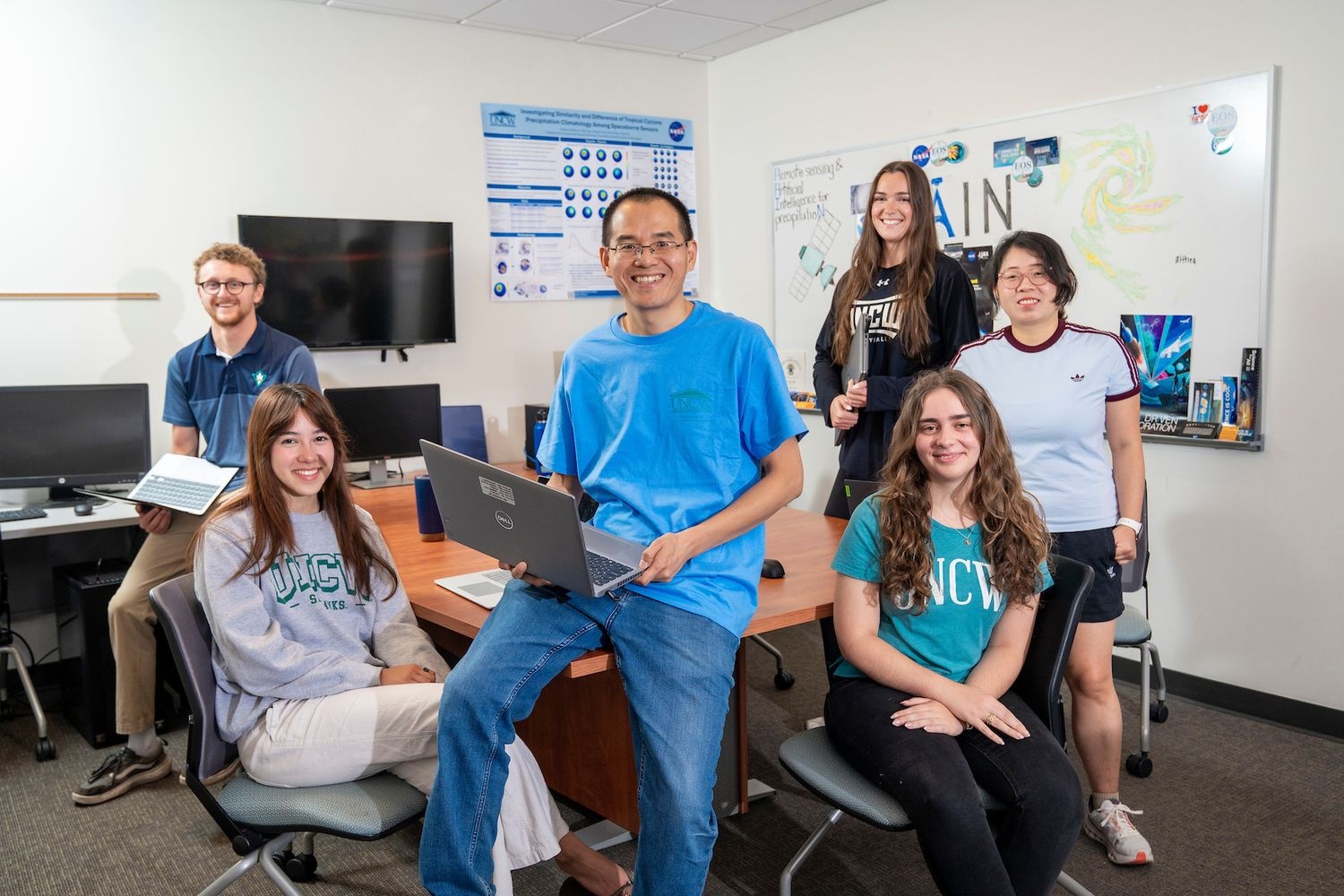
Photo: Jeff Janowski/UNCW
UNCW’s RAIN Lab has joined an elite international team, led by the Japan Aerospace Exploration Agency (JAXA), that is using enhanced satellite data to increase the accuracy of global precipitation measurements. The research includes a special focus on vast expanses of ocean that ground-based weather radar cannot reach.
Yalei You, assistant professor of earth and ocean sciences, is guiding UNCW’s research, which employs artificial intelligence and the Cuttlefish high-performance computing cluster at the Center for Marine Science. The RAIN Lab (Remote sensing and Aartificial Iintelligence for PrecipitationN) is one of only five university/research institute teams outside Japan selected by JAXA as partners in this project.
The international funding is a testament to the strength and reach of UNCW’s research, said College of Science and Engineering Dean Ron Vetter. “This partnership affirms UNCW’s growing global research impact. It reflects the strength of our faculty, the advanced capabilities of our high-performance computing resources and RAIN Lab, and the collaborative ecosystem that supports international-level scientific contributions.”
The research will support JAXA’s cutting-edge Global Precipitation Measurement tool, advancing scientists’ understanding of global weather patterns by integrating satellite remote sensing with artificial intelligence.
“We are essentially using AI to translate complex satellite signals into accurate global rainfall maps, which are critical for improving hurricane and storm tracking and strengthening international disaster preparedness,” You said.
UNCW’s RAIN Lab is among a select group of laboratories worldwide supported by both NASA and JAXA in advancing global satellite precipitation research.
“JAXA identifies only elite research groups globally to partner with our missions,” said Dr. Takuji Kubota, JAXA GPM program scientist. “The RAIN Lab’s expertise is precisely what we seek. This represents a strategic commitment not only to our current mission but to JAXA’s future Precipitation Measuring Mission.”
The advanced computing capacity of the Cuttlefish cluster gave UNCW an edge in securing the $75,433 grant for the university’s part in the project. JAXA has a long-standing partnership with NASA to measure global precipitation.
You’s research enables his students to earn valuable experience in satellite mission operations. “Our students aren't just studying science – they are contributing to it,” he said. “Our ultimate goal is to train the next generation of satellite remote sensing scientists, ensuring that UNCW graduates are among the most sought-after candidates for careers in the global aerospace and data science sectors."
Margo Huff ’25, ’27M, a graduate research assistant pursuing a Master of Science in Geoscience with a concentration in geospatial technologies, says the project aligns perfectly with her thesis topic.
“My research focuses on a critical innovation for the future of precipitation remote sensing missions: small satellites,” she said. “I am eager to integrate JAXA's high-resolution products to better understand how these emerging technologies can further improve our global monitoring capabilities."
You’s assistants this academic year are students and postdoctoral researchers representing the United States, China, South Korea and Sri Lanka. “The RAIN Lab is a premier example of how UNCW is building meaningful scientific connections across the globe and bringing world-class talent to the university to solve these global challenges,” said Jennifer Fernandez-Villa, interim associate provost for global partnerships and international education.
Campus partners supporting the project include the College of Science and Engineering, the Center for Marine Science, and Sponsored Programs and Research Compliance (SPARC), which navigated the 13- to 14-hour time difference between Wilmington and Tokyo during months-long negotiations to finalize the terms of the grant.
“The RAIN Lab is a blueprint for how we want to grow research and support this kind of ambitious, data-driven inquiry,” said Kate Nooner, associate CSE dean for faculty policy, research and innovation.