


Growing Intelligence
How a UNCW student-faculty collaboration is using AI and robotics to help farmers make smarter decisions from the ground up.
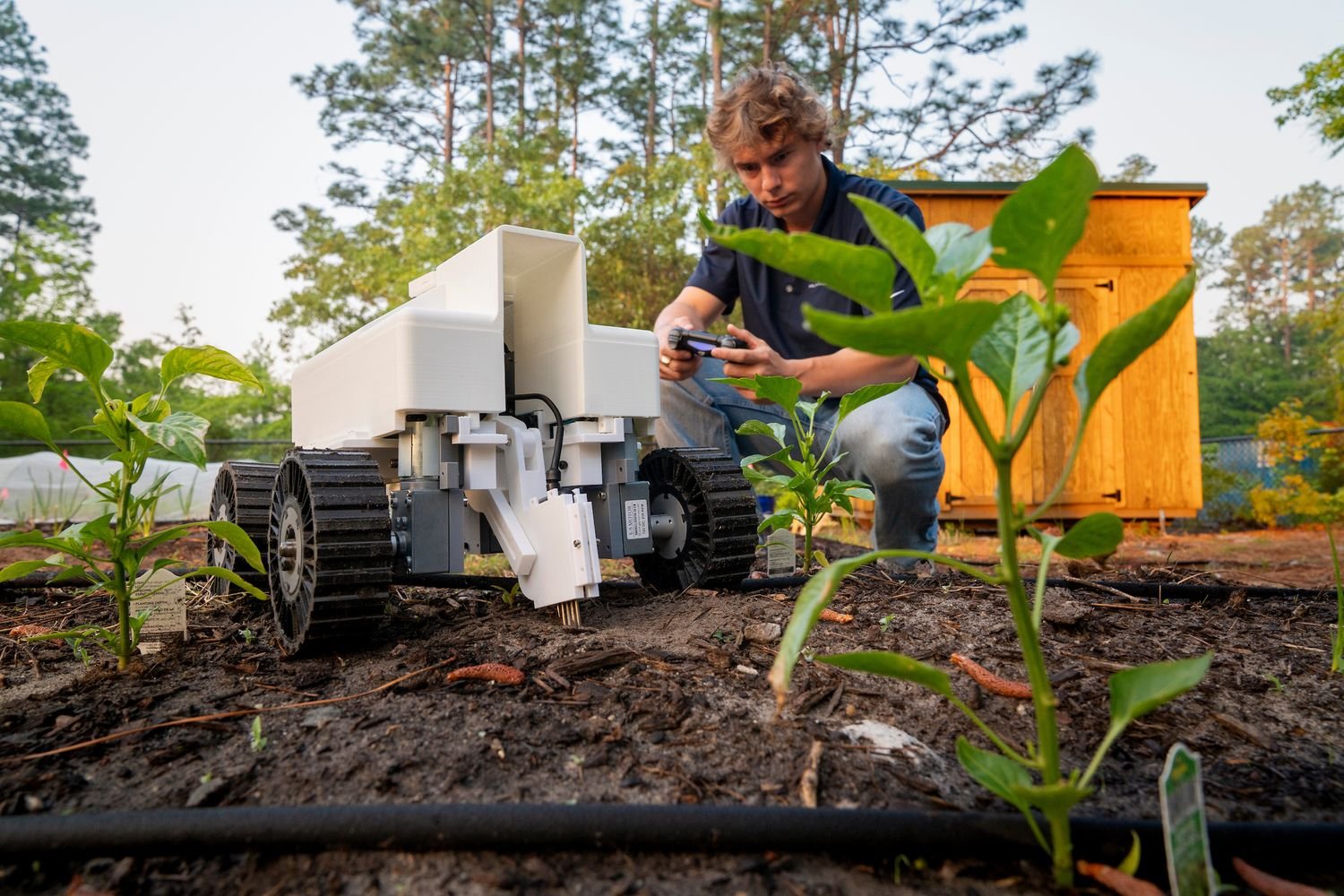
Photo: Jeff Janowski/UNCW
It started with a suburban backyard garden but could provide the decision-making tools that farmers and others need to cultivate their land for long-term viability. It’s called SanaSolo, and its creators compare the autonomous rover to an outdoor Roomba® vacuum cleaner; only it performs soil analysis rather than just sweeping up dust.
Laavanya Rachakonda, assistant professor of computer science and director of the Smart and Intelligent Physical Systems (SIPS) Laboratory at UNCW, was looking to expand her research beyond her original healthcare focus. She invited students in her Introduction to Intelligent Systems class to reach out with their own ideas. Samuel Stasiewicz ’26 was one of her first students to show an interest in soil agriculture.
The UNCW senior launched his initial foray into gardening during the pandemic. “I just kind of threw some potatoes in the ground,” he said. After a summer of ignoring his garden beds, he dug up more than 20 pounds of vegetables. This early success led Stasiewicz to learn all he could about low-input, small scale, community agriculture. “It was a whole new world of science and engineering for me to explore.”
His older brother, one of the first students in UNCW’s coastal engineering program, had advised him to look for a professor who inspired him and a research project to get involved with. Stasiewicz took his advice and submitted a proposal to Rachakonda, kicking off a years-long collaboration. That first proposal, to measure earthworm populations based on the chemical composition of the soil, evolved into a multipronged research effort.
“Our solution is something that will grow with the user,” Rachakonda explained. “It will adapt to the lifestyle of the user and also to the plant and soil.” She calls what she’s building with Stasiewicz and other students the TerraSense ecosystem. It will ultimately be a network of interconnected agricultural robots designed to support sustainable, accessible farming practices. SanaSolo analyzes soil chemistry, fertility and health. A “snake bot” aerates the soil by burrowing across a field, and a partner system, TerraSana, evaluates plant nutrition from the top down. A fourth component concerns itself with the health of the TerraSense user.
SanaSolo’s progress has unfolded both in and out of the lab. While president of the UNCW Garden Club, Stasiewicz put a handheld SanaSolo prototype to work in the campus gardens. The experience of putting his own technology to work sparked new insights, and an updated version was deployed in campus gardens this spring. Together with Rachakonda, he has presented at national and international conferences hosted by IEEE, a leading organization for engineers and other technical professionals. While stuck in airports for about 30 hours to and from one of those conferences in Greece, Stasiewicz said, he ended up doing most of the creative ideation for SanaSolo’s latest version.
Incorporating industry experts will help SanaSolo match such global reach after its release. College of Science and Engineering Dean Ron Vetter brought in David Knight, a former executive with John Deere, the well-known manufacturer of agricultural machinery. Knight has taken an advisory role in the project, making connections with industry engineers who can provide guidance on robotics and sensing systems. The UNCW Center for Innovation and Entrepreneurship’s IDEA Test Lab provided a structured approach to identifying the system’s business value and recognized its potential with a third-place award. The system also received funds from NCInnovation’s Pipeline Development Initiative, designed to advance promising ideas toward proof of concept and future grants.
Rachakonda has built a multidisciplinary team to combine traditional computer science with machine learning and artificial intelligence. As an intelligent systems engineering (ISE) major, this appealed to Stasiewicz.
"We get to focus on AI and robotics, and that’s the biggest wave in technology that we’ve seen since the internet. Maybe even bigger than the internet.” -Samuel Stasiewicz '26
He sees no limits to what he can explore through ISE. The knowledge and skills he’s putting to use can be applied across industries or domains. While he’s creating an agricultural robot, others are working on medical interventions or video game opponents. “You can really just take your passion and run with it,” Stasiewicz said.