

Capstone Projects Have High Impact on Coastal Engineering Graduates
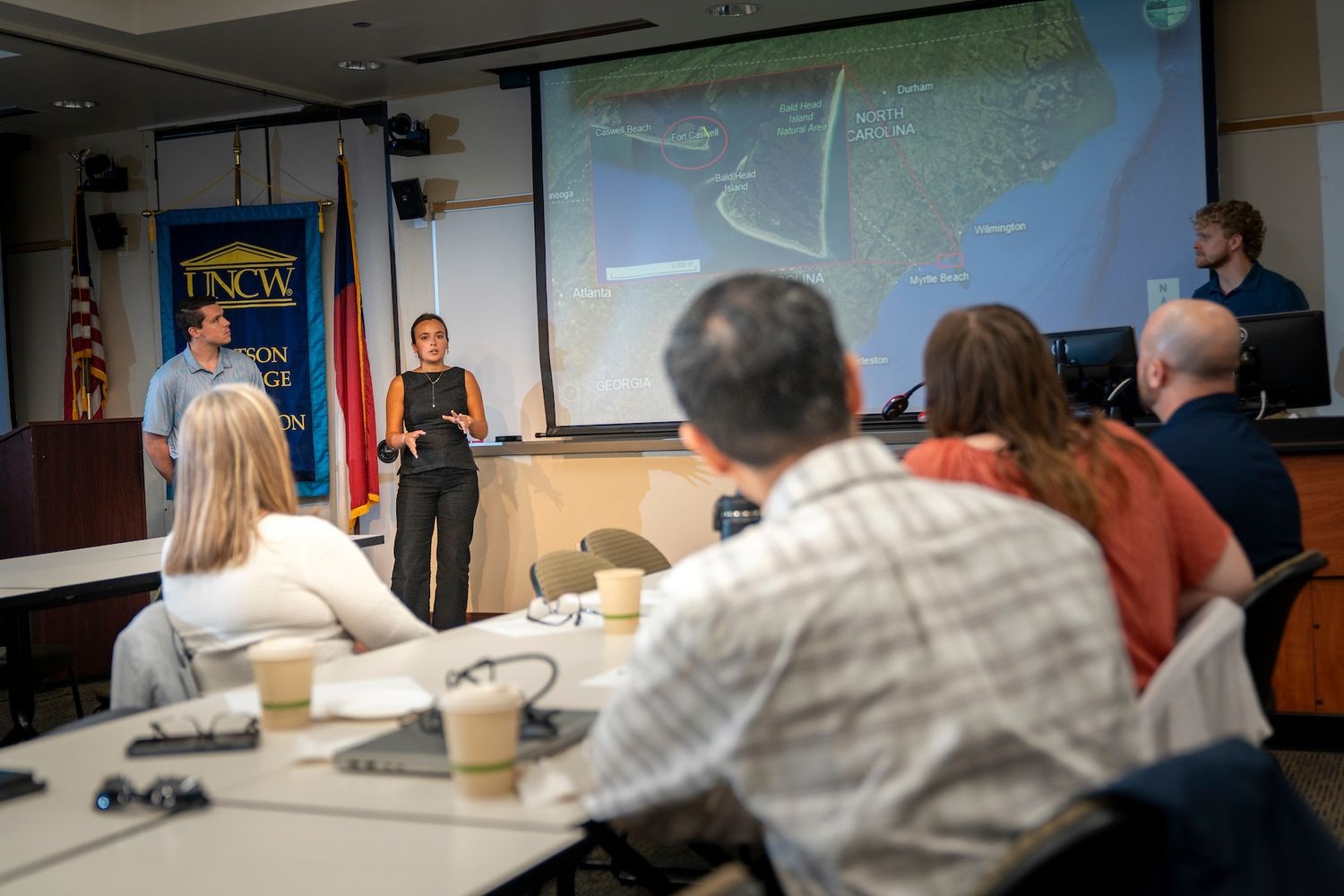
Photo: Jeff Janowski/UNCW
A class of coastal engineering graduates have a taste of what awaits them in terms of career engineering.
Greg Williams, assistant professor of practice in coastal engineering, received a High Impact Practices Faculty Fellowship for 2025-26 to support the development of industry-supported capstone projects in his dredging and beach nourishment class. These projects provide students work-based learning in the community. The grant also facilitated a partnership with English faculty member (and course co-instructor) Ian Weaver to assist with technical writing.
In June 2025, a call for proposals was sent to the Coastal Engineering Advisory Board and other friends of the program, which included consultants, municipalities, government agencies and alumni.
Thirteen project proposals were evaluated by faculty, who decided on the final eight class projects. The team projects included an evaluation of the stability of memorial reefs offshore of Wrightsville Beach, three dredging-related projects, two stormwater projects, shoreline stabilization and marsh management.
Williams took 10 of the 31 seniors to a UNCW-specific short course at the hydraulic laboratory of KSB-GIW, Inc. in Grovetown, Georgia, to learn about dredge pumps and slurry transport in pipelines.
The student team of Alex Chinigo, Arden Ganse, Jacob Gillespie and Emily Weber selected a project studying shoreline stabilization in Fort Caswell, North Carolina, namely aiming to mitigate the erosion and instability on the east facing shoreline along the Cape Fear River.
The group conducted extensive data collection at the site to gain a better understanding of the shoreline topography, nearshore currents, wave climate and sediment transport direction. They used the data in multiple numerical models to analyze the impact of various design solutions.
Ganse said the level of independence the team was given in the course was the most surprising component.
“Our group was responsible for organizing a deployment and retrieval plan for data collection, as well as justifying the use of each instrument. While we had support from our professors, the responsibility placed on us is unlike any course I have taken previously. I feel that this level of independence is some of the best preparation for transitioning into industry work," she said.
Chinigo echoed appreciation for the freedom the group had. “We were able to deploy two pressure sensors and an ADCP in the surf zone, as well as collecting beach surveys and setting up sand traps on the beach. We even got to take a drone out which allowed us to get some great imagery," he said.
The students also learned the importance of client communication, learning that one solution might be the most effective but not the most feasible due to cost, environmental impact and other factors.
“At the beginning of the course I didn’t know about the challenges facing Fort Caswell," said Weber. "This was my first time visiting the area, and it’s been interesting to learn more about this area and the history and the challenges this shoreline faces. The collaboration between client and engineer has been a great learning experience.”
Gillespie summed up the experience of seeing the entire process from project proposal to final design. “Engineers typically aren’t involved in more than one aspect of a project, so I have greatly enjoyed getting experience in a wide variety of work," he said. "This class has taught me much about practical, real-world, engineering practices and has given me experience that will prepare me well for the workforce.”
The final projects were presented on April 22 at the spring advisory board meeting.
The UNCW Bachelor of Science in Coastal Engineering program was launched in 2019, the first engineering degree for the university and the first of its kind in the U.S. The program is housed in the Coastal Engineering Building, a cutting-edge facility equipped with a 24-meter wave flume that holds 9,500 gallons of water.
This article has the following tags: Research & Innovation myUNCW - Students CSE - College of Science & Engineering myUNCW