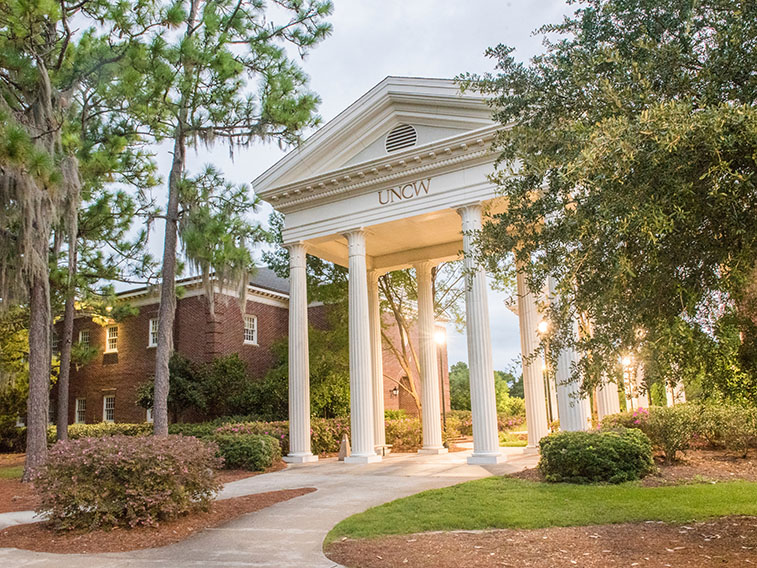
UNCW History faculty and students strive to form a vibrant learning community. To understand us, you have to see some of the forms that community takes, and some of the best work it does. Explore the teaching, research and service efforts we highlight here. There are always new ideas about the past, and new ways to work together to think about them and enrich our understandings of what the past means
Seminar and Research Classes
Our undergraduate offerings in HST 290 and at the 400-level are the critical experiences for our undergraduates. In small seminars capped at 12 students, faculty and students explore history in and historical research in topically-focused research and reading courses. Recent topics have included the First World War, the history of fascism and anti-fascism, global commodities, the Indian Wars, Revolution in the Middle East, and Modern Ireland, and the Harlem Renaissance, among others.
Small Reading Colloquia
In HST 395, small groups of students and faculty read and write around a shared topic and a set of historical questions, engaging closely with historical writing and growing as readers and as historical thinkers. Recent topics have included The British Empire, Magic, Science and Witchcraft, and Command and Leadership.
Research Active Professors
UNCW's history classrooms are filled with active researchers, beginning with the faculty. We regularly produce scholarship published by top international presses-Cambridge University Press, Oxford University Press, The University of Wisconsin Press, Palgrave Press, and UNC Press.
Talking History!
In a typical year, history faculty offer more than fifty public talks all around the Cape Fear region, North Carolina, and around the world. Last year, department faculty spoke to thousands of people on subjects like Women in Africa, the history of African Americans in Education, the Civil War in the Cape Fear Region, Irish immigration, the "Lost Colony," and many other areas. We love bringing the university and our expertise to the public, and sharing our passion for the past.