
At the Center of Ancient Roman Pottery
UNCW archaeologist reconstructs everyday life in the ancient Roman world while offering insights into human behavior
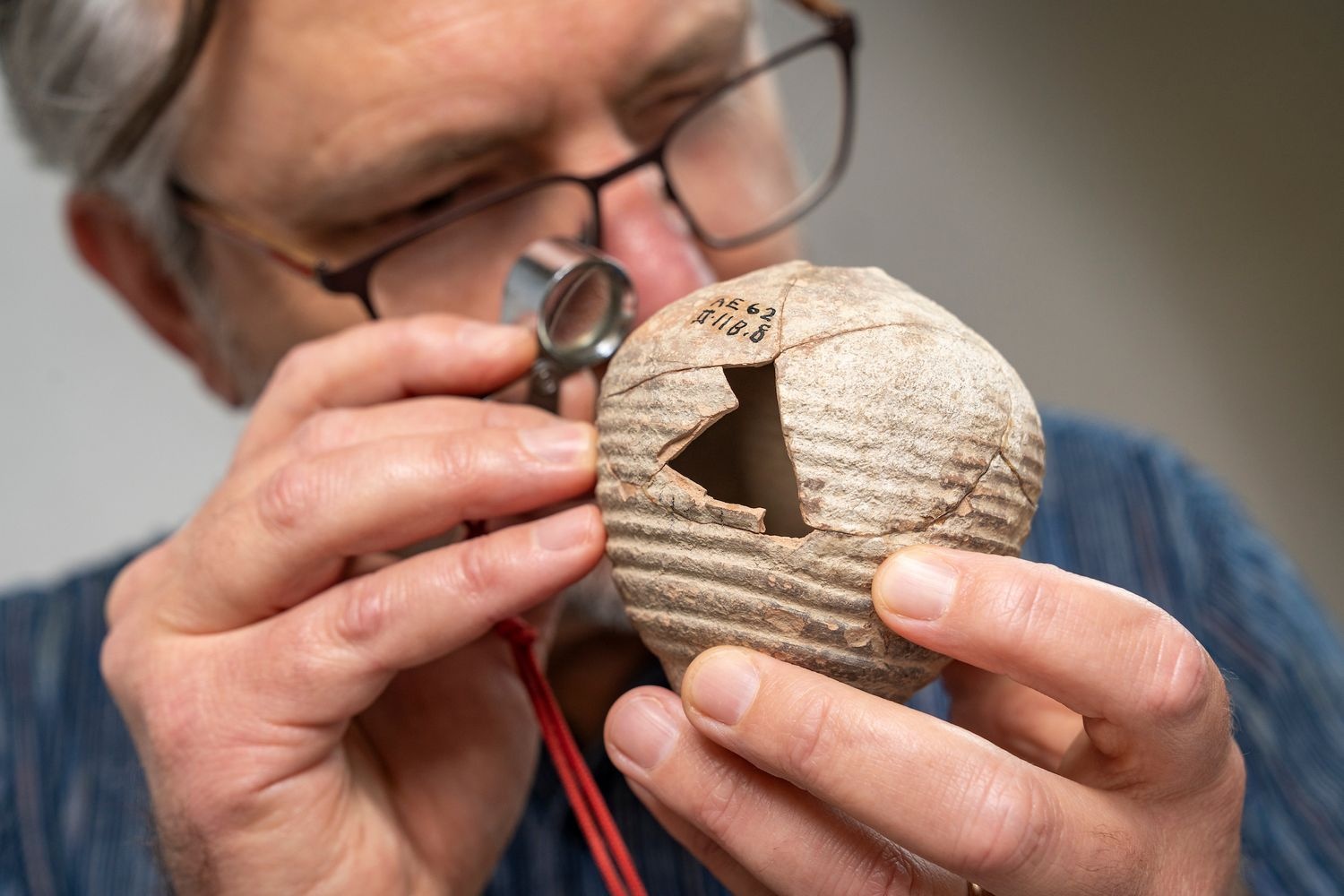
Photo: JeffJanowski/UNCW
Seated in his office on the second floor of UNC Wilmington’s Cultural Arts Building, Nick Hudson turns over a terracotta-colored pottery fragment, running his fingers along the worn edges and studying the shallow grooves etched into its surface. From just a small piece, no larger than the size of his thumb and one of many scattered across his desk, he draws a remarkable amount of information.
“This would have been part of a small plate,” he says, tracing the curves as he reconstructs its original shape in real time.
Hudson moves instinctively through a checklist. He points to the smooth coating, then to subtle variations in color across the surface. Those shifts, he explains, “can reveal inconsistencies in the firing process, indicating lack of control in the kiln.” What might seem like imperfections instead become clues, allowing him to identify where a piece was made, when it was produced and how it fits within broader networks of commerce, social hierarchy and daily life across the ancient Mediterranean.
What appears at first glance to be an unremarkable piece of broken pottery quickly becomes a layered record of ancient craftsmanship. The fragments, known as sherds, offer evidence of how people lived, traded, ate and adapted to the world around them, lending insights into human behavior that still resonate today.
As an archaeologist, Hudson, a professor in the Department of Art and Art History, studies material culture rather than relying solely on the written texts of history. While surviving texts reveal much about the ancient Greek and Roman world, he says the perspectives they preserve are often skewed toward the wealthy and powerful. Studying pottery and other everyday objects offers a way to better understand ordinary people whose voices rarely appear in historical records.
"When we look at the material culture, we can oftentimes find more nuance and diversity of experiences than we get from our primary sources,” he said. “To only look at history through written texts would be as if trying to learn about early 21st century social history by reading the writings of Jeff Bezos or Bill Gates.”
In addition to teaching Ancient Art and Archaeology, Roman Art, and Classical Myth in Western Art, Hudson spends his summers at the Athenian Agora in Athens, Greece, leading efforts to classify and date Roman pottery at the preeminent archaeological site in the eastern Mediterranean.
The Athenian Agora, commonly accepted as the birthplace of democracy, is excavated by the American School of Classical Studies at Athens, one of the leading overseas research institutions devoted to the study of historic and present-day Greek culture. Founded in 1881, the school provides graduate students and scholars a base for research and study in Greece.
For his part, Hudson, the Roman pottery specialist on site, spends his days examining sherds recovered from layers dating between the first century B.C. and the seventh century A.D. By sorting the pieces into categories such as cooking vessels, storage containers and fine wares used for dining, he builds the comprehensive typologies archaeologists rely on to identify and date pottery across the Mediterranean. In the process, he reconstructs the original forms and everyday functions of the objects, tracks changes in production over time and creates a critical reference system used by other archaeologists to interpret material from sites throughout the region.
Hudson was handpicked for this prestigious position by the American School in 2023, taking over for the late John W. Hayes, who Hudson describes as the grandfather of Roman pottery studies. Hayes’ work began in the 1970s, and what Hudson inherited was decades of meticulous but unfinished research, notes, drawings and data. Part of his task now is to carry the work forward, shaping it into a formal typology as part of the Athenian Agora’s “Blue Book” series, a set of reference volumes relied upon by archaeologists worldwide.
The task is daunting. Turning decades of excavation data and analysis into a coherent typology takes years, but the resulting Blue Books carry lasting significance within the field. The publications become foundational references, guiding how material is identified, dated and understood for generations of future researchers.
Central to Hudson’s research process is what is called “legacy data,” referring to materials collected and documented by previous researchers that remain valuable, but they can often be difficult to interpret. For
Hudson, it means taking on extensive amounts of notes, drawings and digital files from Hayes, much of it loosely organized and far from a finished product.
Luckily, Hudson has help. He took on an undergraduate student assistant, Jude Rocco, during the fall 2025 semester who has been working through Hayes’ old files, extracting information and helping make sense of decades of accumulated material. Recently, Rocco began incorporating artificial intelligence tools into the process. Hudson and Rocco were connected through UNCW’s First Year Research Experience (FYRE) program, which pairs first-year students with faculty-mentored research opportunities. Within the program, students work with faculty researchers three to five hours per week during the spring semester while also building communities with peer researchers.
“It’s been huge,” Hudson said. “All this information, all these Word documents that need to be made sense of, Jude has been helping with that process. He’s been learning about the research experience from the perspective of what to do when you have all this old data that is either outdated or nearly incomprehensible, but it represents decades of work.”
Pottery is among the most common artifacts in archaeology and is ubiquitous in Mediterranean excavations, especially at an epicenter of activity like the ancient Athenian Agora. It was used in nearly every aspect of daily life and therefore provides an unusually detailed record of the past.
Typologies, like the one Hudson works on, allow archaeologists to trace how pottery moved across regions, identify where it was produced and reconstruct the trade arteries that connected the ancient Mediterranean. As Hudson pieces together these fragments, he is not only reconstructing broken vessels, but also mapping the systems of exchange, interaction and daily life that defined an entire world.
That same approach of using objects to understand human behavior also shaped his recent book, Dining at the End of Antiquity: Class, Status, and Identity at Roman Tables, which explores how everyday practices like eating and drinking can reveal deeper shifts in social life.
Through both his book and his ongoing work in Athens, Hudson’s research points to something larger than pottery itself: how everyday habits reflect broader social and environmental change. In the Roman world, even something as routine as sharing a meal revealed growing divisions in class and access, with wealthy elites trending toward dining on individual dishes in carefully staged settings while others gathered in smaller homes, sharing food from common bowls on the floor.
Another of Hudson’s current projects examines mugs, jugs and wine-drinking culture in the Roman period. Archaeological evidence suggests that as the ancient climate shifted and winters grew colder during a period referred to as the Late Antique Little Ice Age, people adapted by drinking heated wine. The change reshaped not only drinking customs, but also the pottery itself, creating demand for vessels suited to warming and serving heated beverages.
For Hudson, those moments are where archaeology becomes most relevant. The pottery he studies reveals how ordinary people responded to changing conditions in ways both practical and deeply human. “Humans have always been creatures of change,” Hudson said. “Sometimes it’s slow, sometimes it’s fast.”
Hudson says some of the most exciting moments in archaeology come when discoveries challenge expectations rather than confirm them. “The unexpected is to be embraced,” he said. “Then it just becomes a puzzle. It becomes a mystery, and in many ways, the archaeologist is like a detective, trying to piece together evidence to reconstruct past events.”
Looking ahead, Hudson expects the typology project to remain a central focus of his research for years to come, likely stretching a decade or more before it reaches anything like completion. He is increasingly focused on getting it out into the field as quickly as possible, hoping not to leave another puzzle for others to sort through. “I don’t want the same thing to happen where I die before I’m done, and then somebody has to do what I’m doing,” he said. Archaeology is ultimately collaborative and cumulative, with each generation building upon the work of the last.