

Revisiting the Revolution: America Founded on Ideals
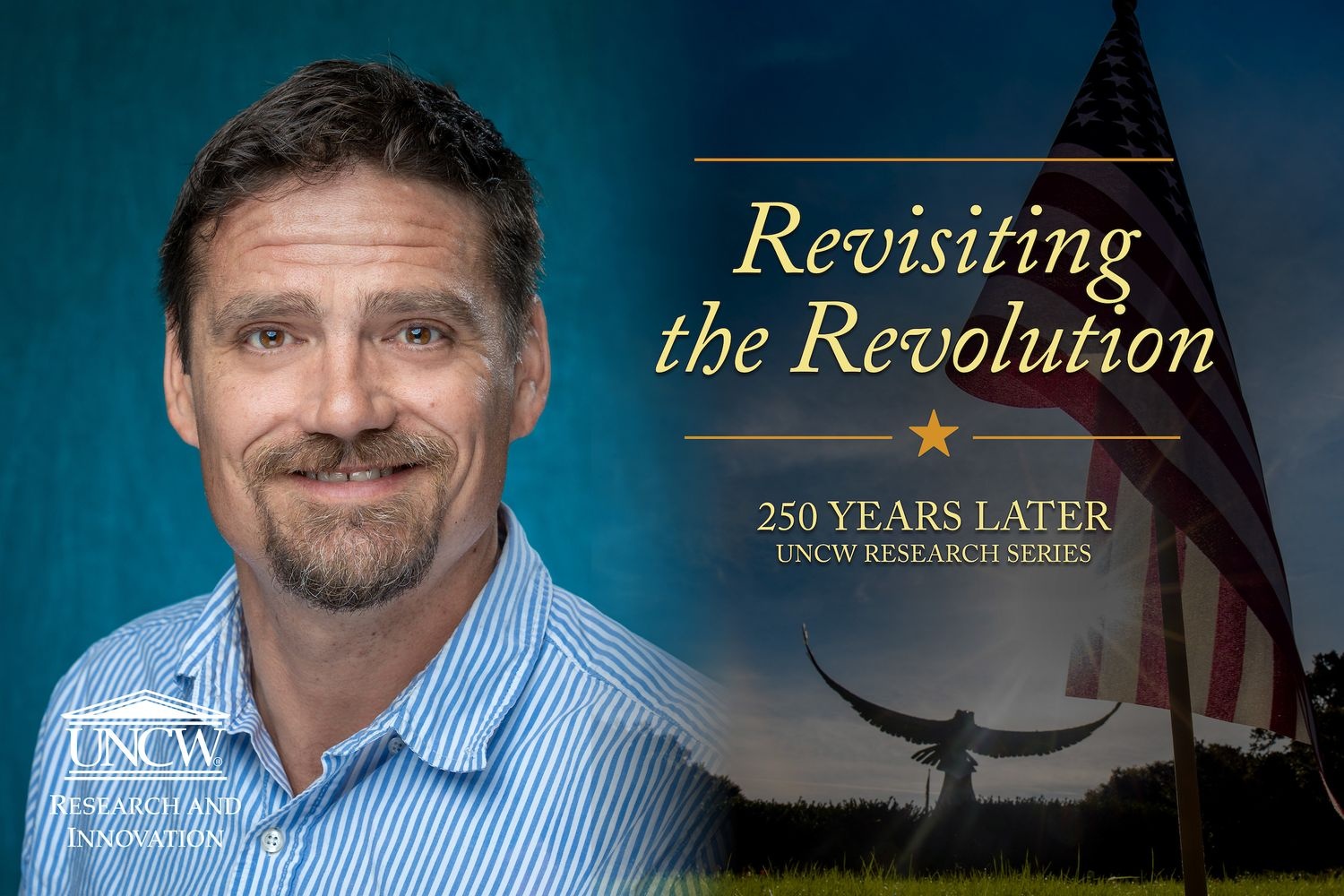
Photo: JeffJanowski/UNCW
This article is part of the Revisiting the Revolution Series. Read More From The Series
Associate Professor David Houpt, a historian of late eighteenth century America with a focus on the political culture of the post-Revolutionary period, has devoted much of his work to separating facts from fiction in how Americans remember and understand the Revolution. One of the most common misconceptions he points to is the idea that the American Revolution and the Revolutionary War are the same thing. In his teaching and research, Houpt focuses less on the war itself and more on the political ideas that emerged from the era.
"Truth be told, I don't care too much about the war," Houpt said. "What's interesting about separating the two is it forces you to start defining what actually was the American Revolution."
Houpt's research centers on the political and philosophical questions that emerged after independence, particularly how early Americans tried to translate the idea of self-governance into a functioning political system. His first book, To Organize the Sovereign People: Political Mobilization in Revolutionary Pennsylvania, examines those debates in the wake of the Declaration of Independence. More recently, he has focused on common myths about the Revolution, why they persist and what they reveal about how Americans have historically understood themselves.
He argues that the Revolution remains central not only in education and popular culture, but in nearly every major political debate in American life because the United States was built around an idea rather than a shared ancestry or culture.
"America is an invented country. We don't really have a shared religion, we didn't have a shared culture," Houpt said. "What we have is the Revolution."
Because of that, he said, modern political disagreements often come back to competing interpretations of what America is and what it is supposed to be.
"You cannot understand the arguments that we have — the political divides — without understanding what took place and the debates over what took place," said Houpt.
His research also shows that interpretations of the Revolution have shifted significantly over time, particularly since the civil rights and women's rights movements of the 1960s and 1970s. While earlier narratives focused heavily on prominent founding figures, newer scholarship examines slavery, inequality and perspectives historically left out of the story. The result, he argues, is a more complicated understanding of the Revolution that highlights both its ideals and its contradictions.
Houpt said his own approach to the Revolution early in his career was shaped by a desire to challenge what he saw as inherited national mythology, calling himself somewhat of an iconoclast or mythbuster. Over time, however, he softened that stance and thinks more carefully about what those myths reveal about the country's ideals as well as its tensions.
"Each generation should return to the American Revolution and make it their own," said Houpt. "What should be celebrated is this belief that there is an idea that can hold us together ... What all Americans had in common was the belief in the idea of America. But that's for each generation to reinterpret."
Houpt's current book project, part of Bloomsbury's Facts and Fiction series, explores common myths about the Revolution and why they endure. Among them are the idea that Paul Revere rode shout, "The British are coming," that the Declaration of Independence was signed on July 4 and that the Founding Fathers shared a unified vision for the nation.
Houpt is serving as chair of the committee organizing the 2026 Sherman Emerging Scholar Lecture, the History Department's annual public lecture series. This year's event will feature Eva Landsberg, who will present "Sons of Liberty, Sons of Slavery: The Caribbean Roots of the American Revolution on October 14, Additional events connected to the lecture and the nation's 250th anniversary will take place throughout the fall.