


Lt. Governor Launches Jobs Initiative, Highlights Cyber Workforce Development
Courtesy: Ibrahim Capar/UNCW
North Carolina Lieutenant Governor Rachel Hunt visited UNCW on Oct. 14 to announce her new Jobs of the Future initiative and highlight UNCW's leadership in cybersecurity education, applied research and workforce development.
The initiative, part of Hunt's broader Future-Ready North Carolina plan, focuses on highlighting workforce development programs that help North Carolina's strongest industries evolve. Cybersecurity is a key priority as businesses, government organizations and critical infrastructure sectors face increasingly complex digital threats.
"North Carolina has always been at its best when we prepare our people for what's next," Hunt said. "That means building the workforce we need for growing fields like cybersecurity while continuing to innovate in the industries that have long been strengths for our state."
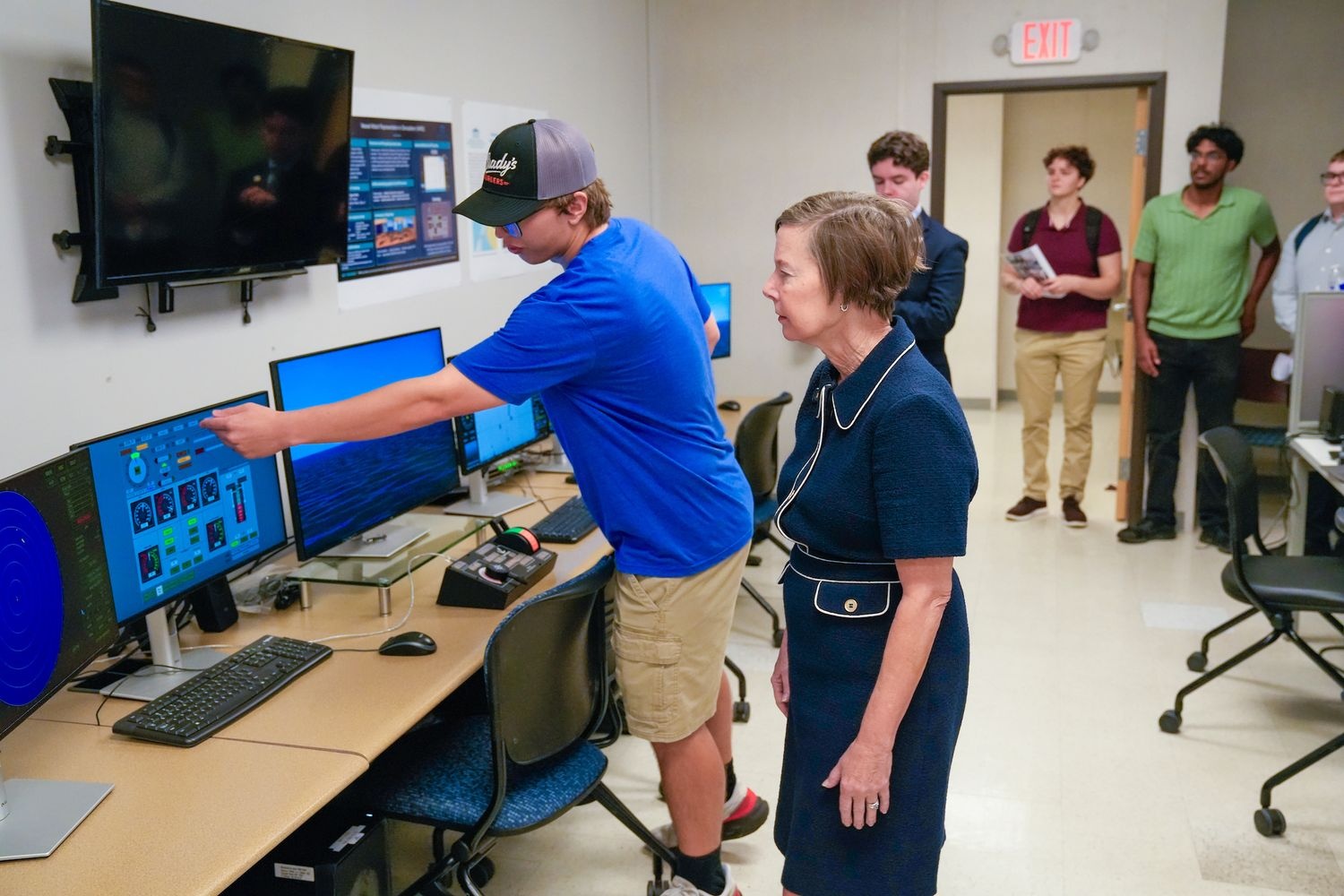
During her visit to UNCW’s Center for Cyber Defense Education (CCDE), Hunt met with university leadership, faculty and students to learn about the university's interdisciplinary approach to cybersecurity education and its efforts to develop a skilled workforce.
Founded in 2018, CCDE serves as UNCW's hub for cybersecurity education, research and workforce development. The center brings together expertise from the Cameron School of Business and the College of Science and Engineering, connecting technical cybersecurity education with business, risk management and critical infrastructure protection.
UNCW launched the UNC System's first undergraduate cybersecurity major in 2022 and continues to expand educational pathways, including a graduate certificate in Critical Infrastructure Cybersecurity.
A highlight of the visit was Hunt's tour of the BlueCyber Lab, part of UNCW's Maritime Cybersecurity Applied Research, Technology and Education Center (MCARTEC). The lab provides specialized environments for applied research, cybersecurity testing and experiential learning involving maritime technologies and operational systems.
MCARTEC focuses on strengthening the cybersecurity and operational resilience of the maritime transportation sector, including ports, vessels and interconnected digital infrastructure. Its work addresses the growing convergence of information technology (IT) and operational technology (OT), where cyber incidents can affect not only information systems but also physical operations, safety and the movement of goods.
The visit also showcased UNCW's hands-on workforce development initiatives. Students shared their experiences in cybersecurity research, competitions and professional development, while university leaders highlighted the Security Operations Center apprenticeship initiative, which provides opportunities to develop practical cybersecurity skills.
Student research is another important component of UNCW's approach to cybersecurity workforce development.
Through a directed independent study with faculty members Song Yang and Sima Jafarikhah, cybersecurity student Scott Marvin helped develop and analyze an artificial intelligence-driven system for assessing software vulnerabilities. He later discussed the project and its findings during an interview for an internship with Volvo Group. "My work at UNCW led to my internship at Volvo Group, and I cited my findings in the interview," said Marvin. "This fall I'm researching ship security, where I get to learn in school and create value for the profession at the same time."
Other students emphasized the importance of faculty mentorship and access to professional development opportunities.
"From internships to research projects, Dr. Clark and my professors have guided me to many opportunities where both my professional and academic skills were developed," said Lillian Cannon, who is double majoring in information technology with a concentration in cybersecurity and cybersecurity with a concentration in cyber operations. "Their mentorship has been one of the highlights of my UNCW experience, and I am so excited to see our cybersecurity program gain more attention."
"Cybersecurity is no longer just about protecting data. As digital technologies become increasingly integrated with physical operations, we need professionals who understand both IT and OT systems, particularly in critical infrastructure sectors," said Ulku Clark, professor of cybersecurity and information systems and director of CCDE. "Through interdisciplinary education, applied research and partnerships with government and industry, UNCW is preparing students for these emerging workforce needs while helping strengthen the resilience of our economy and critical infrastructure."
Hunt’s visit underscored the connection between higher education, economic development and national security. With North Carolina's ports and other critical infrastructure supporting commerce across the state and nation, developing a cybersecurity-ready workforce is increasingly important.
Through the CCDE and MCARTEC, UNCW continues to expand opportunities for students to gain practical experience, engage with industry and government partners and prepare for careers protecting the technologies and infrastructure on which modern society depends.