University of North Carolina at Wilmington


Department of History


Graduate Handbook


2008 - 2009


The University of North Carolina at Wilmington is committed to equality of educational opportunity and does not discriminate against applicants, students, or employees based on race, color, national origin, religion, sex, age, or handicap.  Moreover, The University of North Carolina at Wilmington is open to people of all races and actively seeks to promote racial integration by recruiting and enrolling a larger number of black students.  Questions regarding access to programs following Title IV, Title IX, and Section 504 should be referred to Mr. Samuel B. Connally, Compliance Officer, UNCW Chancellor's Office, 601 S. College Road, Wilmington, NC 28403-3297, (910)962-3840; 962-4050 (fax).


Table  of  Contents


   I.        Introduction:  The University of North Carolina at Wilmington……………………………..     ...      3


  II.        The Master of Arts in History ..................................………………………………………….…     4


 III.        Admission Requirements ........................................... ……………………………………..…..    4


            A.      Qualifications……………………………………………  ...............................................      4

            B.      Documents to be submitted……………………………………. ....................................      5

            C.      Application Procedure……………………………………….  ........................................      5


  IV.      Program Description and Degree Requirements   ………………………………......................      6


            A.      Total Hours ...........................……………………………………………….....................      6

            B.      Grades ................................……………………………………………….......................     8

            C.      Transfer Credits .......................…………………………………………….....................      9

            D.      Other Requirements .....................…………………………………………....................      9

                     1.      Residence ........................………………………………………….......................      9

                     2.      Foreign Language .................………………………………………......................      9

                     3.      Comprehensive Field Examination ..……………………………….......................    10

                     4.      Thesis/Internship .................…………………………………………....................    12

                     5.      Degree Time Limits  ................………………………………………....................    12

                     6.      Continuous Enrollment ................................... …………………………………..    13


   V.      Graduate Courses ...............................................………………………………………………    14


  VI.      Academic Procedures ............................................……………………………………………    19


            A.      Graduate Advising ..........................................…………………………………………..    19

            B.      Thesis .....................................................………………………………………………..    19

            C.      Grievance Procedures .......................................………………………………………....    19

            D.      Admission to candidacy and application for graduation   ......…………………………….    20

            E.      Graduation .................................................………………………………………………    21


 VII.       Teaching Assistants ............................................…………………………………………….…… 22

            A.      University appointment procedures……………………………………………….…………..   22

            B.      Departmental selection procedures……………………………………………….…………    22

            C.      Job description……………………………………………………………………….…………    23

.

VIII.       Graduate Faculty …………………………………….......................................………………..    24


I.       INTRODUCTION:  The University of North Carolina at Wilmington


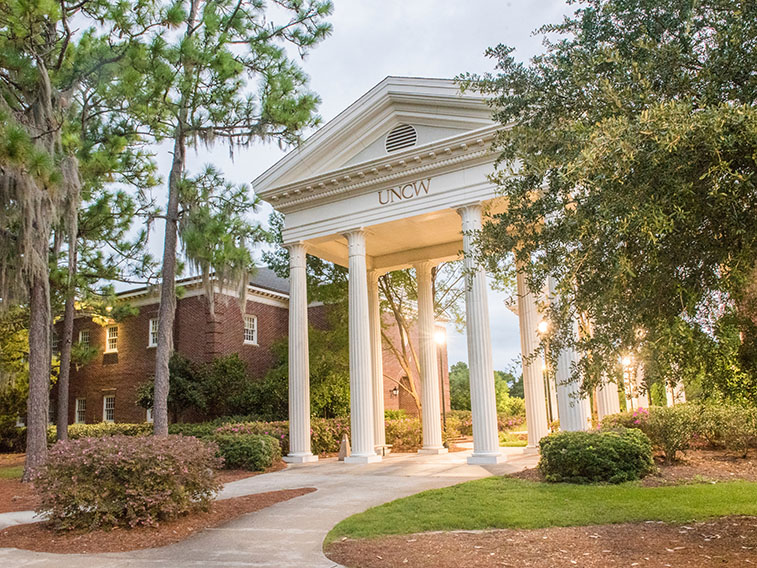
         The University of North Carolina at Wilmington is located in the southeastern part of the State on a beautifully landscaped 650-acre campus, with buildings of modified Georgian architecture.


         The city of Wilmington is situated on the east bank of the Cape Fear River.  The state's major port, it has a metropolitan population of 150,000, several industries, rich local historical resources, and a developing cultural and artistic base.  Ten miles from Wrightsville Beach and fifteen miles from Carolina Beach, the city's proximity to the ocean provides a delightful year-round climate and varied recreational activities.


HISTORY


         The University of North Carolina at Wilmington was founded in 1947 as Wilmington College, a locally supported and governed institution, to provide the youth and adults of New Hanover County and southeastern North Carolina with an opportunity for two years of university parallel study, semiprofessional training and vocational-technical education at moderate expense.  In 1963 Wilmington College became a four-year institution authorized to offer the bachelor's degree, and in 1969, renamed the University of North Carolina at Wilmington, it became a constituent institution of the University of North Carolina system.


         Graduate studies were authorized at Wilmington in 1977; the Master of Arts program in History was inaugurated in August 1989.


ACADEMIC STANDING


         The University of North Carolina at Wilmington is accredited by the Southern Association of Colleges and Schools and the North Carolina Association of Colleges and Universities.  It also holds membership in the Council for Advancement and Support of Education, the American Council on Education, and the American Placement Council, and is on the list of schools approved by the American Chemical Society.


II.       THE MASTER OF ARTS IN HISTORY


         The Department of History offers a program of study leading to the Master of Arts degree in History.


         The goals of the program are:  (1) to provide guidance in research, using historical documents and archives,

          and (2) to familiarize students with the methods, techniques, historical background, and current research

          and debates concerning the study of history.


            From these goals, the following objectives are derived:


                     (1)     to develop research competence in European, U. S.,  

                              Global, and Public history;


                     (2)     to develop professional competence in the application of         

                              historical skills in a non-academic setting;


                     (3)     to develop a level of research competence in history adequate

                              for continuing toward the doctoral degree, and


                     (4)     to add to the body of historical scholarship with meaningful

                              scholarship in European, U. S., Global, and

                              Public history.


III.         ADMISSION REQUIREMENTS


            A.      Qualifications:


                     Students seeking admission to the graduate program in history will normally be expected to meet

 the following qualifications:


                     1.      hold a bachelor's degree from an accredited college or

                              university or its equivalent from a foreign institution based

                              on a four-year program;


                     2.      have a strong overall academic record with a 3.0 grade point

                              average in the last 60 hours of undergraduate instruction;


                     3.      earn a minimum score of 950 on the combined verbal and quantitative

                              sections of the GRE, and a suitable

                              score on the essay.  Scores will be accepted from the five

                              years prior to application.


                     Students will be accepted into the program who have majored in

                     history or other humanities, social sciences, and related fields. 

                     Admission decisions will be based on careful examination of several

                     factors; where other indications of success warrant, individuals

                     who fall below the specific criteria in one of the areas may be

                     considered for admission.  Individuals may also be accepted with

                     certain deficiencies provided these are remedied.  This may include

                     taking additional courses beyond the 30 hours normally required for

                     the degree.          


            B.      Documents to be submitted:


                     1.      An application for graduate admission


                     2.      Official transcript(s) of all previous undergraduate and

                              graduate study


                     3.      Official scores on the GRE (subject test not required)


                     4.      An appropriate writing sample, preferably a college history

                              paper


                     5       Three letters of recommendation by individuals in

                              professionally relevant fields.  For recent graduates

                              (five years) holding a bachelor's degree, two of the

                              recommendations must come from members of the academic

                              community


                     6       A 250-word essay describing the reasons for studying history at

                              UNC Wilmington and the specific area within the main field of

                              history in which the applicant intends to concentrate.  The

                              Graduate Committee is charged with paying special attention to

                              an applicant's reason for wishing to pursue graduate study at

                              UNC Wilmington


7               Deadline for Fall admission is May 1 (March 1 for full consideration

         for  financial aid); deadline for Spring admission is November l.


            C.      Application Procedure


                     All requests for information and all completed applications should

                     be submitted to the office of the Dean of the Graduate School of

                     the University of North Carolina at Wilmington.  The Graduate

                     Committee of the History Department will screen all applications

                     and recommend the appropriate action to the offices of the Dean of

                     the College of Arts and Sciences and the Graduate School. 

                     Notification will be sent to candidates by the Graduate School.


IV.        PROGRAM DESCRIPTION AND DEGREE REQUIREMENTS:


            A.      Total hours


                     1.      For U. S., European and Global concentrations.


                              The program will require a minimum total of 30

                              semester hours of graduate study, which will include the

                              following specified minimum course work:


                              3 hours in HST 500:  Historiography and Methodology Seminar.

                              This required course, which is offered each Fall Semester,

                              must be completed by the end of the second semester of

                              graduate study.                                                                                               


                              12 hours of course work in the student's area of concentration

                              (U. S., European, Global, or Public).


                              9 hours of electives, which includes the option of taking two

                              graduate level courses (or 6 credit hours) outside the                                          

                              Department of History in consultation with the Graduate

                              Director and Thesis advisor.


                              6 hours of thesis.


                              Stipulations:


                                       At least 2 courses must be graduate-only seminars, and 1 of

                                       these 2 must be in the student's area of concentration.


                                       Of the 24 hours of course work (excluding thesis credit), 18

                                       hours must be taken in courses open only to graduate students.

                                       Graduate courses that are cross-listed with the undergraduate

                                       courses will have additional requirements and different

                                       standards for graduate students.


                                       Students may take up to 6 hours of Directed Independent Study

                                       (HST 591).  No more than 3 hours may be undertaken with one

                                       instructor.


                                       Students are expected to complete the foreign language translation

                                       examination.  It is strongly recommended that students take the

                                       language exam within the first 2 semesters.


                                       Comprehensive written exam must be taken during the last

                                       Semester of course or the semester immediately following.


                                       Courses whose topic transcends our four tracks, either

                                       topically or geographically, will carry credits appropriate to

                                       field of expertise of the course instructor.


                     2.      For Public History concentration.


                              3 hours in HST 500:  as in A.1 above.


                              3 hours in HST 570.


                              12 hours in Public History.  (including 570, 573)


                              9 hours of electives, which includes the option of taking two

                                       graduate level courses (or 6 credit hours) outside the

                                       Department of History in consultation with the Director

                                       of Public History and Graduate Director.


                              3 hours of Internship in Public History (HST 598) and 3 hours

                                       of Thesis (HST 599).  Students may begin their internship

                                       only after completing all other coursework.  Internships

                                       must be arranged in consultation with the student's

                                       adviser.


                              Stipulations:


                                       At least 2 courses must be graduate-only seminars, one of which

                                       must be in Public History.


                                       Of the 24 hours of course work (excluding Internship) 15 must

                                       be in courses open only to graduate students.  Graduate

                                       courses that are cross-listed with undergraduate courses

                                       will have additional requirements and standards for

                                       graduate students.


                                       Students may take up to 6 hours of Directed Independent Study

                                       (HST 591).  No more than 3 hours may be taken with one

                                       instructor.


                                       Courses whose topic transcends our four tracks will carry

                                       credits appropriate to the field of expertise of the

                                       course instructor.


                                       Students are expected to complete the foreign language translation 

                                       examination.  It is strongly recommended that students take the

                                       language exam within the first 2 semesters.


Graduate Program in History

Sample Four-Semester Schedule


Semester 1

HST 500

colloquium

cross-listed

** take language exam


Semester 2

Seminar

6 additional hours


Semester 3

Seminar

3 additional hours

prepare for comps

**take comps


Semester 4

6 hours of thesis or internship

**defend thesis/present internship.


            B.      Grades


                     Course performance evaluations are reported by means of

                     the following grade system:


                                              A (4 gp)        -      excellent

                                              B (3 gp)        -      completely satisfactory

                                              C (2 gp)        -      minimally acceptable

                                              F (0 gp)         -      failure

                                              I                   -      incomplete

                                              S                  -      satisfactory progress on thesis

                                              WP              -      withdraw passing


                     Instructors may opt to employ a -/+ grading system.  They will

                     will inform students of their intention at the beginning of term.

                     Three grades of C or one grade of F results in dismissal from

                     the graduate program.  Further, if a student falls below a

                     3.0 gpa at any time, he or she goes on academic probation and has

                     three subsequent courses to bring the gpa up to at least 3.0. 


                     In addition, a student must have at least 3.0 gpa in order to begin

                     any program-specific comprehensive examination or thesis work.

                     Students who have been dismissed from the graduate program and

                     readmitted by special action of the graduate dean shall have their

                     subsequent retention policy determined individually by the Dean.


                     An incomplete grade may be given if the course instructor

                     determines that exceptional circumstances warrant extending the

                     time for the student to complete the course work.  The instructor

                     may set the maximum allowable period for completion of the course

                     work, but in no case will the extension exceed one year.  If the

                     time allowed is to be less than one year, this information should

                     be transmitted in writing to the student, with a copy to the dean

                     of the Graduate School.  If, within 12 months, a change of grade

                     has not been submitted by the instructor, the incomplete

                     automatically becomes a F.


                     A graduate student who is required to take undergraduate courses,

                     whether to make up a deficiency or as part of his or her graduate

                     program, must make grades of at least a "B+."  Those voluntarily

                     electing to register for undergraduate courses may make any grade

                     above "F" without jeopardizing his/her graduate standing.


            C.      Transfer credits


                     Graduate courses taken at this institution before formal admission

                     to graduate studies will meet course requirements for a graduate

                     degree only if offered and approved as transfer credit by the

                     History Graduate Committee.  (No more than six credit hours of such

                     courses are eligible for transfer.)  A maximum of six semester

                     hours of credit may be transferred from another accredited

                     institution.  Correspondence courses will not be accepted for

                     transfer credit.  Each request must be accompanied by an official

                     transcript showing satisfactory completion of courses offered for

                     transfer credit.  The courses must have been taken within

                     allowable time limits for the degree. 


                     A student in the graduate program who wishes to take one or more

                     courses elsewhere for graduate degree credit must obtain prior

                     approval from the Dean of the College of Arts and Sciences and

                     the Dean of the Graduate School.


            D.      Other requirements


                     1.      Residence


                              A minimum of 24 hours of graduate study must be completed in

                              residence.


                     2.      Foreign Language


                              Graduate students in pursuit of an MA degree in History must

                              demonstrate satisfactory reading knowledge of a foreign language.

                              Students will satisfy this requirement by passing a translation

                              examination in one of the following languages:  French, German,

                              Spanish, Latin, Russian, Portuguese, Arabic, or Italian.  (Students

                              wishing to be examined in a language other than those listed are

                              requested to see the Graduate coordinator.) All incoming students

                              to the History Graduate Program MUST sign up and take the

                              language exam within their first two semesters in the program.

                              The examination will last 90 minutes, during which time students

                              must translate a passage of approximately 500 words.  Use of a 

                              dictionary approved by the department is permitted.  Translation

                              examinations will be offered twice each academic year (once each semester). 

                              Examinations will be scheduled by the Graduate Coordinator, who

                              will announce the date at least one month in advance.  The date

                              will be posted on the Graduate History bulletin board, located

                              near Morton Hall 212 (students are urged to check this board

                              frequently for information).  Students are expected to submit,

                              in writing to the Graduate Coordinator, their intent to sit for

                              an examination.  This notification of intent must be received

                              at least two weeks prior to the examination date.  There is no

                              penalty if a student changes his/her mind and decides not to

                              attend the examination.  Once the student enters the

                              examination room, however, he/she must take the examination.


                              Each examination will be graded on a pass/no pass basis. 

                              Students will have as many opportunities as needed to demonstrate

                              their proficiency.  If a student does not succeed on his/her first

                              attempt, he/she is encouraged to continue taking the exam each

                              semester until they pass it. However, this requirement must be

                              fulfilled prior to the scheduling of a thesis defense.


                     3.      Comprehensive Field Examination


                              All graduate students in the Department of History must

                              successfully pass a written comprehensive examination in the

                              student's area of concentration.  This exam must be taken

                              either in the semester in which the student completes 24 hours

                              of course work or in the semester immediately following the

                              completion of 24 hours of course work.


                              The comprehensive exam is offered twice a year, once each

                              semester, but not during the summer sessions.  The Graduate

                              Coordinator will schedule the exam and announce the date at

                              least one month in advance of the test.  The exam date will be

                              posted on the Graduate History Bulletin Board (located outside

                              Morton Hall 212) and students are urged to check this board

                              frequently for information.  Students are expected to submit,

                              in writing to the Graduate Coordinator, their intent to sit for

                              the exam.  Notification is expected at least two weeks prior to

                              the exam date.  Once the student enters the exam room, he/she

                              must take the exam.


                              Each field exam (U. S., European, Global, and Public)

                              will be prepared by three faculty members (appointed by the

                              Graduate Coordinator) representing their respective fields. 

                              Each field exam committee will be constituted for one year, and

                              will have the responsibility of preparing, administering, and

                              grading the exam.


                              Students sitting for the same field exam will be given the

                              same test in a given semester, but questions will vary each

                              semester the exam is given.  Students are instructed to bring

                              two or more blue exam booklets or laptop and pens to the exam. 

                              The exam will be closed book and must be completed within four

                              hours.  Students in American and European history must choose

                              two questions from a field of three.  Students in Global and

                              Public history must choose one of two questions from two

                              fields.  Global fields will be global  history generally and

                              the student’s chosen field (Latin America, Africa, etc.). 

                              Public fields will be public history generally and American

                              history either before or after 1865.


                              The History Department recommends that graduate students

                              familiarize themselves with the basic information provided in

                              the undergraduate history survey courses (HST 101, 102, 103,

                              201, and 202).  While it is expected that the answers to the

                              comprehensive field exam questions will be interpretative and

                              will include historiographic references, it is also expected

                              that a student's essay will provide enough (correct) factual

                              information to support the student's argument.  Please consult

                              the "General Guidelines for Evaluating History M.A. and M.A.T.

                              Comprehensive Exams" for further information about the

                              department's criteria.  These handouts are available from the

                              Graduate Coordinator.


                              The comprehensive exam will be graded by all members of the

                              field exam committee, each member of the exam committee

                              independently rendering a pass or fail decision.  In the case

                              of a failing grade, the grader will provide a written analysis

                              of the exam's deficiencies.  A STUDENT MUST PASS BOTH QUESTIONS

                              WITH AT LEAST A TWO TO ONE (PASS/FAIL) RATION TO EARN A PASS ON

                              THE COMPREHENSIVE EXAM.  No credit is given for passing one

                              question.  If a student fails the comprehensive exam on the

                              first attempt, he/she must retake it in its entirety the

                              following semester.  The same procedures will apply for the

                              second attempt as for the first.  A second failure will

                              result in the student's dismissal from the graduate program.

                              This requirement must be fulfilled prior to the scheduling of

                              a thesis defense.


4.      Thesis/Internship


                              Each student will present a thesis or approved Public History

                              project with accompanying report, acceptable to

                              3 members of the student's thesis committee, prior to

                              graduation.


                              Prior to the completion of the first year of graduate study,

                              and in consultation with the Graduate Coordinator, each student

                              will select a thesis advisor and thesis committee consisting of

                              three to four faculty members.  Three members of the thesis

                              committee must be members of the History Department.  Two

                              members of the thesis committee must be History faculty whose

                              research and teaching interests are in the student's major

                              field of study.  A fourth member of the student's thesis

                              committee may be an especially qualified person who is not a

                              member of the History Department.


                              In cooperation with the thesis advisor, the student will

                              develop a research design for the thesis, not to exceed

                              1000 words in length, and will submit it for approval to the

                              thesis committee and the Graduate Coordinator before the

                              student completes 15 hours of course work.


                              A student may not enroll for thesis hours until he/she

                              has completed 18 hours of course work and has had his/her

                              research design submitted to and approved by the student's

                              thesis committee and the Graduate Coordinator.


                              The principal functions of the thesis committee will be to

                              read and evaluate the thesis, to conduct a thesis defense and

                              to certify the successful completion and defense of the thesis.


                     5.      Degree Time Limits


                              A graduate student has five calendar years to complete his or

                              her degree program.  The five-year period begins with the

                              student's first term of work after formal admission to a

                              degree-granting program.  Work completed as a non-degree

                              student does not initiate the five-year period for completing a

                              degree program.  Courses taken more than five calendar years

                              prior to the admission of a student into a degree program at

                              UNCW normally are not accepted for credit toward fulfilling the

                              requirements of the student's degree program.  In some cases,

                              however, with approval of the student's advisory committee and

                              department/unit chair, a student may petition the Graduate

                              School to accept for credit work that is more than five years

                              old.


                              When extenuating circumstances warrant, an extension of the

                              time limit for completing a graduate program may be granted to

                              a student upon his or her petition to the dean of the Graduate

                              School.  Such petitions must include an explanation and the

                              endorsement of the student's advisory committee and academic

                              unit's chair or dean.


                     6.      Continuous Enrollment


                              All students using university resources (faculty, library,

                              etc.) must be registered during Fall and Spring Semesters. 

                              Students must be registered during the semester in which they

                              plan to graduate (for summer graduation students must register

                              for one summer session).


                              Only 6 hours of thesis or internship may count toward

         graduation.  Students needing to continue enrollment past 6 hours

         must contact the Graduate School for details.


V.         GRADUATE COURSES


            All graduate courses are numbered at the 500 level.  Cross-listed

            courses, which are indicated by a parenthetical 400-level listing,

            carry additional requirements and different grading expectations

            for graduate students.  Students may take two cross-listed courses and

            one Directed Independent Study (HST 591) course or one cross-listed

            course and two Directed Independent Study courses.  Students choosing

            the second option are limited to one DIS per instructor.


            HST 500 is a pre-requisite or co-requisite for all courses.  For

            students admitted spring semester, this requirement will be waived for

            the first semester.


Course Descriptions


HST 500        Historiography and Methodology (3) Introduction to problems of

                     historical research through examination of major historical works

                     and current techniques of research, evaluation of sources,

                     development of bibliography, and quantitative historical methods

                     including the role of the computer in historical research.  This

                     course is open only to graduate students.


HST 518        (440) Seminar:  U.S. Social History (3)  Intensive study of

                     selected topics in U.S. social history.  Examples of topics:

                     African-Americans, immigrants, social movements, education, work

                     and leisure, sexuality.  May be repeated under a different sub-

                     title.  May not be applied toward fulfillment of graduate seminar

                     requirement.


HST 520        U. S. Colloquium (3)  Readings and discussion of bibliographies,

                     interpretations, and research trends on a theme offered in American

                     history.  This course is open only to graduate students.  May be

                     repeated one time for credit.


HST 522        U. S. Seminar (3)  Research in the bibliography of specialized

                     topics and use of primary sources to write an original research

                     paper on an aspect of American history.  This course is open only

                     to graduate students.  May be repeated one time for credit.


HST 524        Major Interpretations in American History (3)

                     An application of the historiographic concepts of conflict and

                     consensus in American society to the examination of specific

                     periods or topics in American history.  This course is open only

                     to graduate students.


HST 525        (442) Seminar:  U.S. Economic History (3) Intensive study of

                     significant themes or events in U.S. economic history from the

                     colonial period to the present.  Examples of topics:  economy of

                     Colonial America, 19th-century labor movements, economy of the

                     Antebellum South, agricultural history.  May be repeated under a

                     different subtitle.  May not be applied toward fulfillment of

                     graduate seminar requirement.


HST 526        (444) Seminar:  U.S. Political History (3)  Intensive study of

                     selected facets of political theory, behavior, movements, and

                     institutions, and how political power has been able to influence

                     the development of society.  Examples of topics:  New Deal

                     politics, third-party movements, U.S. Constitution.  May not be

                     applied toward fulfillment of graduate seminar requirement.


HST 527        (446) Seminar:  U.S. Diplomatic History (3) Intensive

                     examination of fundamental principles, assumptions, and objectives

                     in the conduct of U.S. foreign policy, and how Americans have

                     viewed their place in the international order at various moments in

                     their history.  Examples of topics:  the diplomacy of World War II,

                     the Cold War, arms control and disarmament.  May be repeated under

                     a different subtitle.  May not be applied toward fulfillment of

                     graduate seminar requirement.


HST 528        (448) Seminar:  U.S. National Security History (3) Intensive

                     examination of major themes and events in the evolution of U.S.

                     national security and defense policy, the uses of national power,

                     and the role of military affairs from the colonial period to the

                     present.  Examples of topics:  the Vietnam War, the use of air

                     power, U.S. imperialism.  May be repeated under a different

                     subtitle.  May not be applied toward fulfillment of graduate

                     seminar requirement.


HST 529        (450) Seminar:  U.S. Intellectual History (3) Intensive

                     examination of the role of ideas in American history.  Examples of

                     topics:  radicalism, the Enlightenment, myth in American history,

                     and ideas about democracy, ethnicity, equality, religion, gender.

                     May be repeated under a different subtitle.  May not be applied

                     toward fulfillment of graduate seminar requirement.


HST 531        (454) Seminar:  U.S. Regional History (3) Intensive

                     examination of the economic, social, and political history of a

                     specific region of the United States.  May be repeated under a

                     different subtitle.  May not be applied toward fulfillment of

                     graduate seminar requirement.


HST 533        (456) Seminar:  U. S. Environmental History (3)  Intensive

                     Study of selected topics in U.S. environmental history.  Examples

                     of topics:  nature and culture, the cult of the wilderness,

                     Conservation and Preservation, resources and regions, gender and

                     nature, the environmental movement.  May be repeated under a

                     different subtitle.  May not be applied toward fulfillment of

                     graduate seminar requirement.


HST 540        European Colloquium (3) Readings and discussion of major

                     research trends and schools of interpretation in selected themes in

                     European history.  This course is open only to graduate students.

                     May be repeated one time for credit.


HST 542        European Seminar (3) Research in the bibliography of

                     specialized topics and use of primary sources to write an original

                     research paper on an aspect of European history.  This course is

                     open only to graduate students.  May be repeated one time for

                     credit.


HST 548        (408) Seminar:  Medieval Europe (3) Research-oriented

                     exploration of major themes and issues in history of Medieval

                     Europe (500-1500).  May not be applied toward fulfillment of

                     graduate seminar requirement.


HST 552        (412) Seminar:  Renaissance and Reformation Europe (3)

                     Research-oriented exploration of major themes and issues in the

                     history of Renaissance and Reformation Europe (1350-1618).  May

                     not be applied toward fulfillment of graduate seminar requirement.


HST 554        (414) Seminar:  Early Modern Europe (3) Research-oriented

                     exploration of major themes and issues in the history of Early                                      

                     Modern Europe (1618-1789).  May not be applied toward fulfillment

                     of graduate seminar requirement.


HST 556        (416) Seminar:  Nineteenth-Century Europe (3) Research-

                     oriented exploration of major themes and issues in the history of

                     Europe from the French Revolution to the First World War.  May not

                     be applied toward fulfillment of the graduate seminar requirement.


HST 558        (418) Seminar:  Twentieth-Century Europe (3) Research-oriented

                     exploration of major themes and issues in the history of Europe

                     since 1914.  May not be applied toward fulfillment of graduate

                     seminar requirement.


HST 560        Global Colloquium (3) Readings and discussion of

                     bibliographies, interpretations, and research trends on a theme or

                     period in non-Western history.  This course is open only to

                     graduate students.  May be repeated one time for credit.


HST 562        Global Seminar (3) Research in the bibliography of

                     specialized topics and use of primary sources to write an original

                     research paper on an aspect of non-Western history.  May be

                     repeated one time for credit.  This course is open only to graduate

                     students.


HST 564        Modernization and Revolution in the Non-Western World (3) 

                     Examination of industrialization, imperialism, nationalism, and

                     other forces that have revolutionized traditional society in the

                     non-Western world.  This course is open only to graduate students.


HST 570        (470) Introduction to Public History (3) A research seminar

                     that acquaints students with the various sectors of Public history

(government and public policy, archives and information management,

cultural resources management, media and research organizations)

                     and with the research methodologies unique to the field.  Field

                     trips, guest speakers, and a sponsored research project provide

                     practical experiences for participants.


HST 573        Public History Seminar (3) Research in the bibliography of

                     specialized topics and use of primary sources to write an original

                     research paper or complete an original interpretative project on an

                     aspect of public history.  This course is open only to graduate

                     students.   May be repeated one time with different subtitle.


HST 577        (477) Historic Preservation in the U.S. (3) This applied research class

                     provides an overview of the history, theory and practices of historic

                     preservation.  It addresses the history of the built American enviroment

                     and how scholars analyze buildings and landscapes as historical evidence. 

                     Students visit historic structures and conduct both fieldwork and archival research.


HST 580        (480) Topics in Public History (3)  Intensive study of selected

                     themes in Public History.  Examples of topics:  interpretation of

                     landscape, interpretation of material culture, and Business

                     History. 


HST 581        (481) Topics in African History (3) Intensive study of a

                     selected theme in African history.  Examples of topics:  slavery,

                     the slave trade and its abolition, pre-colonial Africa, colonial

                     and post-colonial Africa, oral history in Africa.  May be repeated

                     under a different subtitle.


HST 583        (483) Topics in Middle Eastern History (3) Intensive study of

                     a selected theme in Middle Eastern history.  Examples of topics: 

                     early Islamic conquests, the Ottoman Empire, the Arab-Israeli

                     conflict.  May be repeated under a different subtitle.


HST 585        (485) Topics in Latin American History (3) Intensive study of

                     a selected theme in Latin American history.  Examples of topics: 

                     pre-Columbian civilizations, colonial rule under Spain and

                     Portugal, nationalism, revolutionary movements.  May be repeated

                     under a different subtitle.


HST 586        (496) Topics in the History of Science and Technology (3)

                     Intensive study of a selected theme in the History of Science and

                     Technology.  Examples of topics include:  "Positivism," "Occult

                     Studies and the Renaissance," "The Second Industrial Revolution."

                     May be repeated under a different subtitle.


HST 587        (487) Topics in Global History (3) Intensive study of a

                     selected theme in global history.  Examples of topics: 

                     colonialism, imperialism, industrialization, slavery, revolutionary

                     movements.  May be repeated under a different subtitle.


HST 590        Comparative Historical Studies (3)  Comparison of

                     developments in different eras or places in order to determine

                     unique or common historical themes.  This course is open only to

                     graduate students.  May be repeated one time under a different

                     subtitle.


HST 591        Directed Independent Study (limited to two per student) (1-3)

                     This course is open only to graduate students.


HST 593        Problems in History (3) Investigation of selected problems in

                     European, American, and non-Western history through discussions,

                     development of bibliographies, or a research paper.  May be

                     repeated one time for credit. This course is open only to

                     graduate students.


HST 595        (495) Special Topics in History (3)  Research-oriented

                     exploration of a special topic not regularly covered in other

                     courses.  May not be applied toward fulfillment of graduate seminar

                     requirements.


HST 596        Seminar:  Topics in History (3) Advanced research on

                     specialized topics using primary sources.  This course is open only

                     to graduate students.  May be repeated one time for credit.


HST 597        (497) Topics in Asian History (3) Intensive study of selected

                     themes and events in Asian history not regularly covered in other

                     courses.  Examples of topics include:  the Chinese Revolution,

                     Meiji Japan, Gandhian thought, and the nationalist movements.

                     May be repeated under a different subtitle.


HST 598        Internship in Public History (3) Prerequisite:  HST 570 and

                     permission of the instructor.  Supervised practical experience with

                     a historical agency or other client, resulting in a finished

                     product of historical research and interpretation acceptable to

                     client and thesis committee.  Product must meet standards

                     of professional historical scholarship as defined by faculty and

                     supervising professional.


HST 599        Thesis (1-6) This course is open only to graduate students.


I.           ACADEMIC PROCEDURES


            A.  Graduate Advising:


                     The Graduate Coordinator is responsible for developing a plan of

                     study for each graduate student and for advising each graduate

                     student throughout his/her tenure as a student in the program.


            B.      Thesis


1.             See guide appended to this handbook; consult same on graduate

                              web page.


                     2.      Thesis Approval and Defense


                              A student must submit a completed thesis to his/her thesis

                              committee at least 45 days prior to the end of classes in the

                              semester in which the student intends to graduate.  The entire

                              committee must agree that the defense can go forward, by one

                              week before the date scheduled for the defense.  An oral

                              defense can take place no later than three weeks prior to the

                              end of the semester in which the student intends to graduate. 

                              The format of the thesis defense will involve a public

                              presentation of research results followed by a period of

                              questioning by the thesis committee and the audience.  All 3

                              members of the committee must approve the defense and sign the

                              title page.  After final approval of the thesis, the student

                              must produce three final copies in a format consistent with the

                              requirements of the Graduate School.  Two copies will be

                              deposited in the university library and one copy will be

                              available in the History department.


                     3.      Presentation of Internship


                              Public history students will present their work by arrangement

                              with their internship committee.


            C.      Grievance Procedures


                     1.      Procedure for protest of grade


                              Any student who protests a course grade shall first attempt to

                              resolve the matter with the instructor involved.  Failing to

                              reach a satisfactory resolution, the student may appeal the

                              grade in accordance with the procedures outlined below.  Such

                              appeals must be made no later than the last day of the next

                              regular semester.


                              The student shall present the appeal in writing to the dean of

                              the college or school within which the protested grade was

                              awarded.  By conferring with the student and the instructor,

                              the dean will seek resolution by mutual agreement.  Failing

                              such resolution, the dean will transmit the written appeal to

                              the Dean of the Graduate School.  The Dean of the Graduate

                              School will convene the Grade Appeals Committee.


                                        The Grade Appeals Committee will consist of the Graduate Dean

                              as chairman and five members of the graduate faculty appointed

                              by the Graduate Dean.  If the committee affirms the

                              instructor's decision, the Graduate Dean will notify in writing

                              the faculty member, the student, and the appropriate dean.  If

                              the committee supports the student's appeal, it shall prescribe

                              the method by which the student will be reevaluated.  If the

                              reevaluation results in a grade change, the established Course

                              Grade Change procedure will be followed.  The grade resulting

                              from the reevaluation is final and may not be appealed further.


            D.      Admission to Candidacy and Application for Graduation


                     A student in a master's degree program applies for admission to

                     candidacy at the time of application for the degree.  To be eligible

                     for graduation each student must apply for a specific graduation on

                     or before the deadline shown in the Calendar of Events. 


                     If a student has already applied for candidacy and for the degree,

                     but fails to meet a deadline for a particular graduation, he or she

                     must contact the Graduate School to specify a new graduation date.


                     Instructions for filing application for graduation


                  1.       Fill in the first four (4) lines of the application.  Be sure your

                              name appears exactly as it should be printed on the diploma: 

                              I.e., Jr., Sr., III, etc.  List transfer credit hours if applicable and

                              the courses currently in progress.


                     2.      In consultation with your advisor/graduate coordinator, list courses

                              and all other requirements needed to complete the degree indicated.


                  3.       Your advisor/graduate coordinator should forward the application

                              through the appropriate channels to the Graduate School; however, it is

                              your responsibility to see that the graduation application is

                              in the Graduate School by the last day of classes in the

                              semester before you intend to graduate.


         ANY DEVIATION FROM THE COURSES LISTED ON THE APPLICATION

        FOR GRADUATION MUST BE APPROVED BY THE GRADUATE SCHOOL.


                           A copy of the application will be returned to you (via your address listed

                           on your application for graduation), your advisor, and the graduate

                           coordinator upon approval by the Graduate School.  If your address

                           changes between the time you apply for graduation and the time you

                           graduate, please contact the Graduate School.


                           If graduation requirements are not complete at the end of the semester

                           indicated on the application, you should contact the Graduate School to

                           change the date of graduation.


                E.      Graduation


                     Students may graduate in July, December, or May.  A student

                     graduating in July or December has the option of participating in

                     the December Commencement exercise (diplomas will be awarded at the

                     Department ceremony).  May graduates have the option of

                     participating in the May Commencement exercise (diplomas will be

                     awarded at the Department ceremony).


VII.        Teaching Assistants


            A.      The university has developed the following set of procedures for

                     awarding teaching assistantships (EPA status):


                     1.      Graduate School is notified by the Office of the Provost and

                              Vice Chancellor for Academic Affairs of the number of positions

                              available for the Graduate School.


                     2.      Graduate School notifies dean/department chair of the number

                              of assistantships available for the academic year and requests

                              information regarding students to be awarded an internship.


                     3.      Dean/department chair completes and forwards HR1.35 form to

                              Graduate School for approval along with completed I-9

                              (employment eligibility form) and W-4.


                     4.      The Graduate School administrative assistant verifies

                              information from the dean/department chair, enters information

                              in SIS and signs.  Dean of the Graduate School signs the

                              HR1.35 form.


                     5.      Recommendation is forwarded to the BD-119 coordinator who

                              verifies availability of funds, position, FTE, etc. and

                              forwards the HR 1.35 to the provost for final approval.

                              Upon approval by the provost the HR 1.35 forms are sent to

                              Human Resources for processing.


                     6.      The Graduate School prepares contracts for the provost's

                              signature and mails the contracts to the student.


                     7.      The Graduate School notifies Financial Aid of all awards.


                     8.      If signed contracts are not returned to the Graduate School

                              by the beginning pay date indicated on the contract the check

                              is withheld until contract is returned.


                     9.      Graduate School retains the original contract which is filed in

                              the student file.


                     10.     Confirming copies of the HR 1.35 are sent to the Graduate

                              School via the BD-119 coordinator.


            B.      The History department has established the following procedure

                     for allocating the teaching assistantships made available to the

                     department by the Graduate School.


                     1.      Application for an assistantship may be made as part of the

                              admission process.  This process pertains to prospective

                              graduate students applying for admission to the program for

                              the fall semester.  Graduate students enrolled in the program

                              may indicate their interest in applying for a teaching

                              assistantship by writing a letter to the Graduate Coordinator,

                              who will post a notice on the History Bulletin Board or via e-mail

                              distribution list prior to the end of each semester.


                     2.      Selection is made by the Graduate Committee based on academic

                              records, recommendations, experience, and other relevant

                              criteria.  The amount of the stipend for teaching assistantships is

                              set by the Graduate School.  All students

                              must pay tuition and fees at the established rates.  The

                              History Department may offer a limited number of tuition

                              remission to selected students.  This allows out-of-state

                              students, who must be teaching assistants, to pay

                              tuition at in-state rates.


                     3.      Students  supported by an assistantship must have full-time

                              enrollment status.  While full-time status requires a minimum

                              of nine credit hours, a student considered full-time when

                              enrolled for fewer than nine hours if the student holds a

                              teaching or research assistantship, or is enrolled for zero to

                              three hours of thesis work.  A student may not be considered

                              enrolled beyond two terms of zero thesis hours.  Summer counts

                              as one regular term.  PLEASE NOTE THAT MOST FEDERAL LOAN

                              PROGRAMS CONSIDER 9 HOURS THE MINIMUM FULL-TIME LOAD. 

                              Students carrying fewer than 9 hours will probably receive lower loan

                              amounts.  Failure to notify Financial Aid Office of changes

                              hours and status will result in delayed checks.


                     4.      Teaching assistantships are awarded for one academic year, and

                              may be continued for a second year if the student's performance

                              is satisfactory.  Each semester, the faculty member to whom the

                              teaching assistant is assigned will provide the teaching

                              assistant and the Graduate Coordinator with a written

                              evaluation of the teaching assistant's performance.  The

                              teaching assistant and the professor will sign the evaluation,

                              and a copy will be placed in the teaching assistant's

                              departmental file.  Students who fail to perform assigned

                              duties in a satisfactory manner may have their assistantships

                              revoked at any time.


            C.      Job Description for Teaching Assistants in the History Department


                     The specific duties of the teaching assistant are designated by

                     the faculty member to whom the teaching assistant is assigned.  In

                     general, however, a teaching assistant's duties are limited to the

                     following:  holding a minimum of five (posted) office hours per

                     week, assisting in the maintenance of student records (absences and

                     grades), holding discussions, review or study sessions,

                     participating in staff meetings, obtaining equipment necessary for

                     classroom instruction (maps, T.V./VCR, slide projector), attending

                     classroom lectures, assisting in the preparation and grading of

                     quizzes, tests, exams, and papers, and providing no more than 15%

                     of classroom instruction over the course of a semester.  This

                     figure is equivalent to 4 instructional days for courses meeting

                     twice a week and 6 instructional days for courses meeting three

                     times a week.  Teaching assistants are expected to work between

                     15-17 hours per week, inclusive of preparation time spent outside

                     the classroom and office.  They must attend meetings and training

                     sessions held by the Graduate School or the History Department.


IX.         GRADUATE FACULTY


CANDICE BREDBENNER, Associate Professor

Ph.D. University of Virginia
U.S.
, Women, and Citizenship


YIXIN CHEN, Associate Professor

Ph.D. Washington University of St. Louis, 1995

China, East Asia


WALTER H. CONSER, JR., Professor

Ph.D. Brown University, 1981

American Religion


ANDREW F. CLARK, Professor

Ph.D.  Michigan State University, 1990

Africa


VENKAT DHULIPALA, Assistant Professor

Assistant Professor
University of Minnesota, 2008
India, South Asia


WILLIAM TAYLOR FAIN, Assistant Professor

Ph.D. University of Virginia, 2002

U.S. Diplomatic


CHRIS E. FONVIELLE, JR., Assistant Professor

Ph.D. University of South Carolina, 1994

U.S. Civil War, Wilmington, Old South


PAUL GILLINGHAM, Assistant Professor

Assistant Professor
Oxford University, 2005
Modern Mexico, Latin America


MONICA GISOLFI, Assistant Professor

Assistant Professor
Columbia University
, 2007
New South, Public History


TAMMY GORDON, Assistant Professor

Ph.D. Michigan State University, 1998

Public History, Museum Exhibition


ANTHONY GLENN HARRIS, Assistant Professor

Ph.D. 2002, Florida State University

African-American, American Intellectual, U.S.


DAVID L. La VERE, Professor and Graduate Coordinator

            Ph.D. Texas A. & M. University, 1993

Native American, American West, Borderlands


            SUSAN P. MCCAFFRAY, Professor and Chair

Ph.D. Duke University, 1983

Russia, Modern Europe


            WILLIAM J. MCCARTHY, Associate Professor

            Ph.D. Boston University, 1990

            Spain, Maritime, History of Science


LYNN MOLLENAUER, Assistant Professor

Ph.D. Northwestern University, 1999

Early Modern France, Gender


WILLIAM D. MOORE, Assistant Professor

Ph.D. Boston University, 1999

Public, U.S. Social, Material Culture


LISA L. POLLARD, Associate Professor

Ph.D. University of California, Berkeley, 1997

Middle East, Gender, Islam


MICHAEL M. SEIDMAN, Professor

Ph.D. University of Amsterdam, 1982

Modern France, Modern Spain


DAVID SEPKOSKI, Assistant Professor

Assistant Professor
University of Minnesota, 2002
History of Science


ROBERT M. SPAULDING, JR., Associate Professor

Ph.D. Harvard University, 1989

Modern Germany, Modern Europe


ROBERT B. TOPLIN, Professor

Ph.D. Rutgers University, 1968

Film, Recent U.S., Latin America


PAUL A. TOWNEND, Assistant Professor and Undergraduate Coordinator

Ph.D. University of Chicago, 1999

British, Irish


LARRY W. USILTON, Professor

Ph.D. Mississippi State University, 1971

Medieval England, Ancient Greece and Rome


ALAN D. WATSON, Professor

Ph.D. University of South Carolina, 1971

Colonial, U.S. Economic, Early North Carolina